Architecture in Future Cities: How Can Spaces Adapt as Life Changes?
As households, work, populations and climate change, buildings need room to adapt. M.K. considers repair, changing uses and whether smart systems weaken residents' control over their homes.
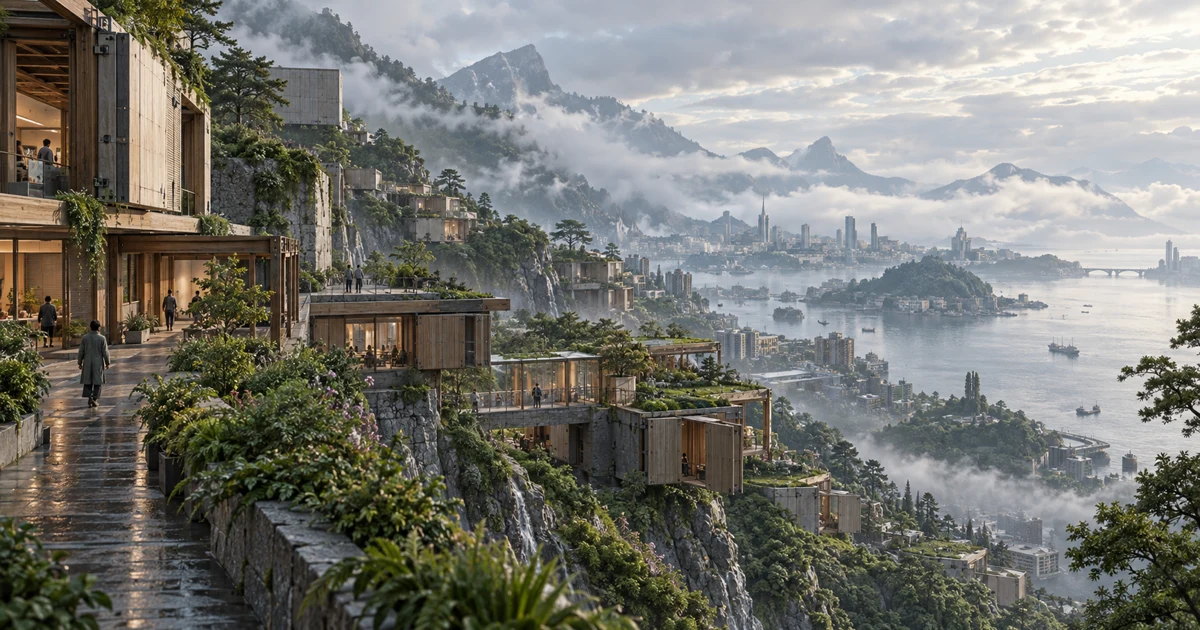
Six Questions About Future Cities 02 | Architecture
The second essay considers one of a city's most solid, and often least changeable, elements.
Today, taking a building from planning and financing to completion often requires years. Once it is finished, we expect it to remain unchanged for decades.
Yet over those decades, household structures, ways of working, population density, climate conditions and technology may all change dramatically. Buildings look solid, but they are often among the parts of a city least able to adapt.
What interests me more than how futuristic a building looks is this: can it change?
A Building Should Be More Than a Product Handed Over
In modern cities, many buildings are financial and real estate products first, places to live second.
Their spaces are divided according to what is easiest to sell, rent or manage at the time. That layout may do little to meet residents' needs ten or twenty years later. Children grow up, parents grow older, work moves into the home and neighbourhood populations change. The space can usually only be awkwardly modified, or demolished and rebuilt.
Buildings designed for long-term change should treat adaptation as a normal condition from the outset.
Walls could be rearranged. Homes could be joined together or divided. Offices could become places for education, care or housing. Building services and outer envelopes could be updated in stages, instead of declaring an entire building obsolete because one of its systems has aged.
Japan's Metabolism architectural movement once imagined cities as living organisms that could grow, replace parts and renew themselves. The idea remains inspiring. But the real challenge is not simply whether modules can be replaced. It is whether regulations, ownership arrangements, financing and management allow spaces to change.
Building technology can be ahead of its time while institutions still lock it in place.
Respond to Climate Before Chasing Form
Many concept images of “future architecture” feature streamlined forms, glass curtain walls, gardens in the sky and vast public decks. But a building's suitability for the future cannot be judged by how beautiful it looks in a rendering on a sunny day.
It has to face actual heat, heavy rain, wildfire smoke, power failures, water shortages and fluctuating energy prices.
Future buildings should function more like environments that actively regulate their conditions: using daylight, shade, ventilation, thermal storage and vegetation to reduce demand; retaining basic habitability in extreme weather; keeping rainwater, energy and materials in circulation wherever possible; and providing manually operated, low-tech backups when smart systems fail.
This is also where my greatest doubts about the “fully automated smart building” lie.
If a home needs a constant connection, a service subscription and remote updates simply to open its doors, ventilate its rooms or adjust the temperature, has it become more capable, or more fragile? When a platform withdraws its service, an account gets locked or a sensor makes the wrong call, do residents still truly control the space they live in?
Intelligence should not mean dependence.
Architecture Holds Culture and Gives Shape to Power
Architecture has never been merely physical space.
It determines who can enter, who is visible, who gets sunlight and a view, and who is placed at the city's edges. Lobbies, walls, access controls, elevators and cameras may look like design details, but each expresses a particular order.
Future architecture that only strengthens identification, separation and control could become highly efficient while losing its public character. When everyone is channelled into separate routes, services and spaces, strangers no longer need to encounter one another. The city gradually becomes a collection of isolated private bubbles.
I hope future buildings will still leave some places incompletely prescribed: stairs where people can meet by chance, porches where they can linger, public seats that require no purchase, and spaces residents can alter and give meaning to themselves.
A city with no room for the unexpected will struggle to produce new culture.
A Building's Life Should Not End in Demolition Alone
Future buildings must also be designed with a question in mind: where will their materials go after leaving their original locations? Today, many buildings are expensively demolished once their use disappears, turning components that still have value into waste. If material origins, specifications and disassembly methods are fully documented, a building could become a temporary assembly rather than the end of the line for its resources.
This kind of circulation is more than an environmental technique. It could also change our aesthetics. Future cities may not strive to look perpetually new. They could accept repairs, replacements and traces of different eras, allowing time to show on the surfaces of their buildings.
Two Architectural Futures in Neo Babylon
When I designed Bay City and 雲滬城 in Neo Babylon, I was doing more than choosing different visual styles for them.
Bay City represents a clean, precise, almost frictionless future. Nature, homes and infrastructure are closely integrated. On the surface, the city appears more comfortable and more rational than cities in the human era. But this perfection conceals another question: when space can anticipate and arrange everything its residents need, how much opportunity do they still have to change the city?
雲滬城 is a different experiment. Through AI's understanding of humanity's Eastern civilizations, it reconstructs upturned eaves, pavilions, waterways and streets. Beneath its classical appearance lie quantum sensors, nanomaterials and automated systems. It is not a return to the past, but a non-human civilization's reinterpretation of human culture.
This keeps bringing me back to a question: what will future architecture preserve—forms, functions, or the memory of a civilization?
The architecture I hope for need not remain perfect forever. But residents should be able to change it, time should be able to revise it, and it should continue to carry culture beyond its technology.
Next: Who Lives in the Future City? When Humans Are No Longer Alone