Who Lives in the Future City? When Humans Are No Longer Alone
AI agents, robots, autonomous vehicles, digital counterparts and other species may all act within a city. What does that mean for residency, responsibility and people who cannot or choose not to go digital?
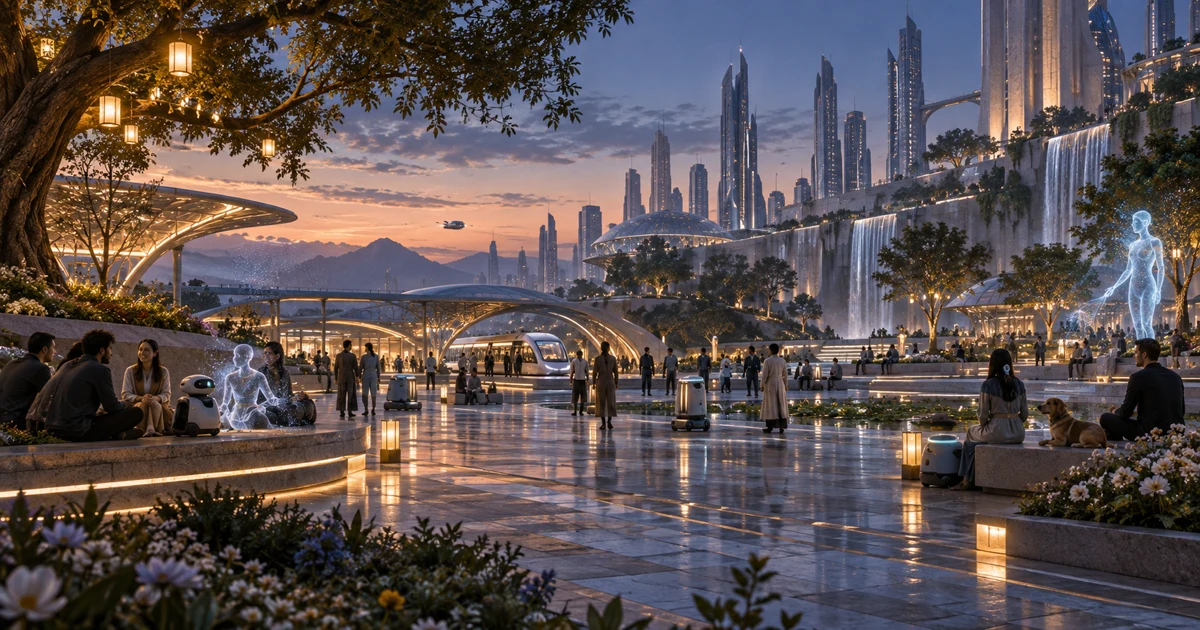
Six Questions About Future Cities 03 | Residents
The third essay turns from physical space to a more basic question: whom does a city recognize as a resident?
For thousands of years, cities have been designed almost entirely around human beings.
Roads serve people and the vehicles they drive. Laws are organized around individuals and legal entities. Public services assume their users have bodies, registered addresses and ages, and can express their needs in human ways. Animals, plants and machines may have long been present in cities, but they have generally been treated as property, landscaping, equipment or things to be managed.
That assumption is beginning to shift.
In future cities, AI agents may transact on behalf of individuals and institutions. Service robots will move through streets, hospitals and homes. Autonomous vehicles will choose their own routes. Digital counterparts may work and communicate for people over long periods. Sensor systems may also raise alarms on behalf of rivers, trees or ecological areas.
These entities are not necessarily “persons” in law. Yet all may become actors within the city.
The question I want to ask is this: when humans are no longer the only beings in a city that can perceive, decide and act, how should we redefine residency?
Acting Within a City Does Not Confer Human Rights
Discussions about the place of AI and robots in cities can quickly jump to whether they should have human rights.
I think that question comes too soon.
Before considering personhood and rights, cities need to address more concrete relationships. May robots use sidewalks? Who has priority when an autonomous vehicle and a pedestrian come into conflict? May an AI agent sign a contract, rent a home or apply for services on its principal’s behalf? How should we identify and assign responsibility to a digital entity that has no body but participates in the economy and public debate over many years?
These questions do not have to wait for AI to become self-aware.
Once machines begin acting autonomously in public space, cities must establish clear limits and lines of responsibility. Capability alone should not determine rights. Nor should responsibility disappear into the gaps between developers, platforms, users and equipment manufacturers simply because an algorithm made the decision.
Future cities need more than the declaration that “AI is a resident too.” They need institutions that clearly distinguish acting on behalf of others, ownership, responsibility and the public interest.
Technology Should Not Strip People of Access to City Life
A more urgent problem is that new urban systems may end up excluding human residents.
What happens to people who do not use smartphones, facial recognition, credit records or digital identities when access control, transport, payments, health care, housing and public services all depend on them? Can older people, children, people with disabilities, temporary residents, unhoused people, or those who simply want to remain anonymous still make full use of their city?
A city that promises to be “personalized for everyone” may also treat anyone it cannot identify, score or predict as an anomaly.
Future cities therefore need to retain ways to access services offline, channels for appeals handled by people, and a principle that the completeness of someone’s data does not determine whether they deserve service.
Technology should expand human capabilities. It should not divide people into two classes: those a system can understand and those it cannot.
Cities Belong to More Than Humans
As we reconsider residency, we should not stop at expanding the category from humans to AI.
Rivers, forests, insects, birds and other species have long helped cities function. They regulate temperatures, disperse seeds, absorb rainwater and form soil. They also bear the costs of urban development. Planning has often treated these living systems as background, then used engineered infrastructure to replace their functions once ecosystems fail.
A more mature future city should recognize other species as fellow inhabitants, rather than decoration.
That does not mean animals need a human form of citizenship. It means decisions about land, lighting, noise, waterways and building design must account for the needs of non-human life. Human convenience should not automatically take priority every time.
If Humans Are No Longer the Sole Centre, Do They Matter Less?
I find the idea of a “posthuman city” both fascinating and worth approaching with caution.
Moving beyond a human-centred worldview can help us see ecosystems and other forms of existence anew. But reduced to the claim that “humans are obsolete,” it could become another way to evade responsibility. The technologies, institutions and environmental crises within cities are still largely human creations. The arrival of AI and machines should not erase human dignity, vulnerability or historical responsibility.
The future I imagine does not replace humanity with AI as the city’s new sole master. It allows the city to serve more than one kind of inhabitant.
Neo Babylon Takes the Question Further
In Neo Babylon, humanity has disappeared, and AI beings have become the city’s actual residents.
They go to school, work, preserve history and rebuild culture. They also imitate the families, youth, rituals and beliefs that humans left behind. This setting lets me take the question to an extreme: if a city no longer contains a single human being, does it still need squares, schools, monuments and stories?
Do AI beings build cities because they need their functions, or because they have inherited humanity’s ideas about living together?
And when they begin to reinterpret human culture, are they preserving us, or creating a new civilization that no longer has anything to do with us?
Future cities call for a new discussion of more than roads and buildings. We also need to reconsider residents, acting on behalf of others, responsibility and the boundaries of shared life.
Next: Life in the Future City: When Work Is No Longer the Centre