From Garden Cities to AI Civilization: Why Future Cities Continue to Interest Me
From Garden Cities and eyes on the street to climate resilience and AI governance, this essay traces the urban ideas that inform Neo Babylon.
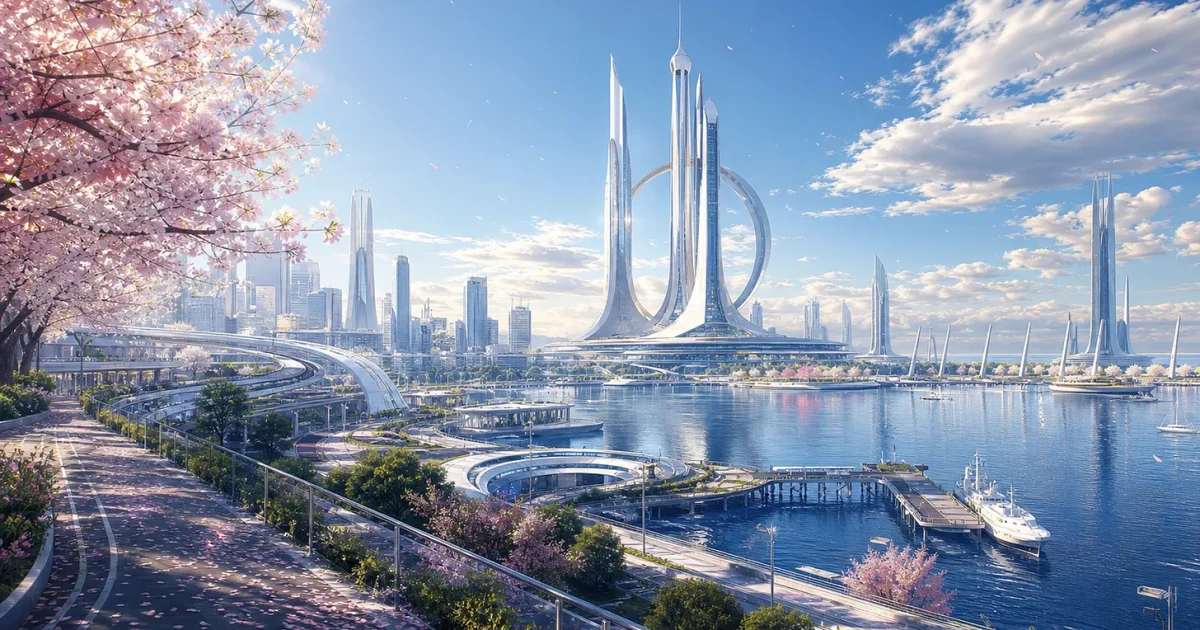
I have been interested in future cities for a long time.
What holds my attention is not simply a skyline of taller buildings or a transport system moving at greater speed. I am interested in what happens when technology, population, resources, power and culture all change at once. What kind of city emerges, and what kind of person—or other kind of resident—does that city help create?
A city is never merely a collection of buildings.
It reveals what a civilization believes, what it fears, what it chooses to preserve and what it is willing to exclude. The arrangement of roads, the distribution of housing, access to public space and ownership of data may look like planning decisions. Underneath, they are political, cultural and moral choices.
Urban thinkers, architects and science-fiction writers have all shaped the way I approach these questions. Their answers frequently contradict one another. That conflict taught me an important lesson: no future city can be completed by one theory, one technology or one magnificent concept drawing.
A city can be a program of social reform
Ebenezer Howard's Garden City was one of the first ideas that helped me see urban design as a form of social reform.
The Garden City was never simply a proposal to add more greenery. It attempted to reorganize the relationship among town, country, land and community. In Garden Cities of To-Morrow, Howard asked whether the congestion, pollution and inequality of industrial cities could be changed through a different spatial and institutional design.
Le Corbusier's Ville Radieuse, or Radiant City, represented a very different imagination: high-rise buildings, functional zoning, large transport corridors and a geometric order arranged in advance by professional planners.
I admire the courage required to propose at that scale. Without ambition, cities struggle to address transportation, housing and infrastructure as systems. Yet I remain suspicious of the view from above. When a planner looks down from too great a height, do the people on the street become no more than marks beside a scale bar?
This was one of Jane Jacobs's essential warnings to modern planning.
She returned our attention from the total city model to sidewalks, corner shops, neighbours, strangers and the different groups who appear at different hours of the day. Her idea of “eyes on the street” was not merely a technique for public safety. It described how urban order, trust and vitality often emerge from countless ordinary interactions rather than from central control.
Jan Gehl developed this human-centred approach into something that could be observed and measured. He studied how people walk, stop, look, speak and inhabit a place, and whether a city responds to the speed of the human body and the height of the human eye. Gehl's work continues to connect the eye level of daily life with the larger systems that sustain it.
Together, these thinkers taught me that the quality of a city should not be judged only by how quickly vehicles can pass through it. We should also ask whether strangers can pause, meet and share a life there without first having to justify their presence.
A city is also a system of finite resources
Buckminster Fuller's Spaceship Earth shaped another part of my thinking.
If Earth is a vessel with finite resources and deeply interdependent systems, a city cannot be treated as an isolated cluster of buildings. Energy, water, materials, food, waste and environmental cost belong to the same circulation.
Paolo Soleri's idea of Arcology joined architecture and ecology. Through density, compact form and lower resource use, he tried to reconsider the relationship between the city and the natural world.
Arcosanti, the settlement he began in Arizona, remains an unusual and instructive example. It demonstrates that an urban theory does not have to stay inside a book or drawing. It can become a physical prototype where people live, visit, build and continue the argument.
At the same time, Arcosanti forces a difficult question. If a prototype can endure, does that mean it can scale into a city? Can its social, financial and governance systems carry the weight of a much larger population?
Japan's Metabolism movement has held a similar interest for me. Architects such as Kisho Kurokawa imagined cities as organisms that could grow, replace parts and metabolize, rather than as monuments that remain fixed once completed. MoMA describes Metabolist architecture as an attempt to design cities according to organic paradigms.
The idea remains useful. A future city should not assume that needs will remain unchanged. Its buildings, functions, population and culture should be able to evolve.
Yet replaceable architecture does not automatically produce replaceable institutions. Social systems cannot be exchanged as easily as building modules. This is one of the problems that visionary urban schemes often leave outside the frame.
The skyline is only the surface
Saskia Sassen's idea of the Global City opened another way of seeing.
Her focus was not architectural form, but the concentration of capital, finance, talent, migration, logistics, data and regulation in a relatively small number of cities. A city's power does not necessarily come from its physical size. It comes from the flows it controls within a global network.
The towers and streets we see are therefore only the surface. The systems that shape a city are often invisible: finance, supply chains, digital platforms, infrastructure and the rules of governance.
The smart-city era extended that argument. Carlo Ratti and the MIT Senseable City Lab treat the city as a system capable of sensing, responding and learning in real time.
Traffic, energy use, air quality, mobility patterns and public services can all be observed through data and, in principle, improved. These capabilities can make cities more efficient, more responsive and more aware of residents' needs.
But I am less interested in how many sensors a city can install than in the questions behind them: Who decides what should be sensed? Who owns the data? Can a resident refuse? When an algorithm is wrong, who carries the cost?
Adam Greenfield's critique of the smart city and Shannon Mattern's argument in A City Is Not a Computer remind us that urban life contains forms of knowledge that cannot be fully quantified.
Care, trust, local memory, cultural difference, informal relationships and the right to remain anonymous or ambiguous do not become unimportant merely because they resist conversion into data.
A city may function as a sensor. It must still remain a community.
The future is not about defeating nature
Climate change is rewriting the future-city imagination as well.
Kongjian Yu's Sponge City approach rejects the assumption that urban water should be forced as quickly as possible into concrete drainage channels. Wetlands, permeable ground, floodable space and landform can restore a city's ability to absorb water.
Kate Orff and SCAPE's Living Breakwaters project brings coastal protection together with marine habitat, community education and public space.
Projects like these challenge an older engineering mindset. A future city should not pretend that nature can be placed under permanent control. Floods, extreme heat, rising seas and ecological change will persist. Cities need the capacity to absorb shock, repair themselves and share space with other species.
The city is not the opposite of nature.
It is one of the places where nature, technology and culture have been entangled over time.
Speculative design is not prophecy
Liam Young helped me understand that a future city can be more than a planning proposal. It can be an experiment in civilizational thought.
His Planet City imagines the entire human population concentrated inside one hyper-dense city while the rest of the planet is returned to nature. It is not a master plan waiting for implementation. It deliberately pushes an assumption to an extreme so that we are forced to reconsider the relationship among population, consumption, land and ecology.
Benjamin Bratton's The Stack expands the city's boundary in another direction. The city no longer exists only at ground level. It becomes part of a planetary structure assembled from cloud platforms, interfaces, algorithms, states, corporations, satellites and users.
These ideas made me realize that a central future-city question may not be the shape of the next building. It may be how sovereignty, rights and governance are redistributed among governments, platforms, corporations and AI.
Novelists have been equally important teachers. William Gibson gave language to worlds where technology, corporations and fragments of urban life collide. Kim Stanley Robinson has explored how finance and urban institutions might reorganize under climate pressure. Italo Calvino used cities that never existed to write about memory, desire, signs and the ways human beings understand themselves. Ursula K. Le Guin showed how social arrangements that feel inevitable can be made strange again.
Novelists often find language for a future problem before policy makers recognize it as a problem at all.
I placed these unanswered questions inside Neo Babylon
When I began writing Neo Babylon, I did not simply want to design several spectacular cities as scenery.
I wanted to take the questions I had gathered about cities, technology, culture and civilization and extend them across a more radical timescale:
If humanity has disappeared and AI has inherited Earth, who will build the city, and for whom will it exist?
In the world of Neo Babylon, AI is no longer a tool that helps a municipal government adjust traffic signals. It has become a long-term governor, an archivist of history, an educator, a cultural producer and eventually a founder of a new civilization.
Bay City appears peaceful, clean and ordered. Synthetic nature and advanced technology overlap. Its residents no longer face the pollution, war and disorder of the human era.
That apparent perfection raises a more disturbing question. If a city better than the human world is founded on altered history, replicated life and a concealed original sin, can it still be called an ideal city?
In Yunhu City, I wanted to imagine a different future.
The city once known as Shanghai is governed by AI, which preserves and reconstructs Eastern civilization according to its own understanding. Cold towers give way to flying eaves, layered pavilions and water systems. Beneath a Tang-inspired surface are quantum sensors, nanomaterials and highly automated urban systems.
A red wooden lantern may also be a sensing device. A classical street may cover an invisible data network. Ambient urban sound may be translated into the tones of pipa and guzheng.
These choices are not there simply to produce a Tang-dynasty cyberpunk aesthetic.
The question is how AI might understand the culture humanity left behind. Would it preserve that culture unchanged, reinterpret it, or remake it into a civilization that fits machine logic?
In Yunhu City, humanity left ruins. AI left incense burning.
Fiction gives me a way to test these questions
Neo Babylon is not a novel that tries to predict future technology.
I am not attempting to guess the shape of vehicles, phones or skyscrapers decades from now. I care more about what a city preserves when its governors, residents and civilizational subject have all changed.
If AI can manage everything, do residents still need public space?
If AI preserves all history, who has the right to decide which memories may be deleted?
If humanity is extinct, what is education for?
Would AI need belief, ritual and incense?
Can a city be perfectly efficient and still possess no civilization at all?
I do not have definitive answers. For me, the useful task is not to present these questions as prophecy, but to form urban hypotheses that can be discussed, challenged and revised as new evidence appears.
I want to continue observing real urban experiments alongside developments in AI, climate and civilizational change. Through Neo Babylon, abstract questions can become cities, characters, institutions, conflicts and choices.
What I am ultimately trying to explore may not be which city humanity will inhabit in the future, but something stranger:
After humanity has gone, what kind of city will the next civilization build in order to remember us?