Future City Governance: Does Better AI Management Make Us Freer?
AI can help manage transport, energy, public safety and services. But governance goes beyond optimization: who sets the goals, how can residents object, and who answers for mistakes?
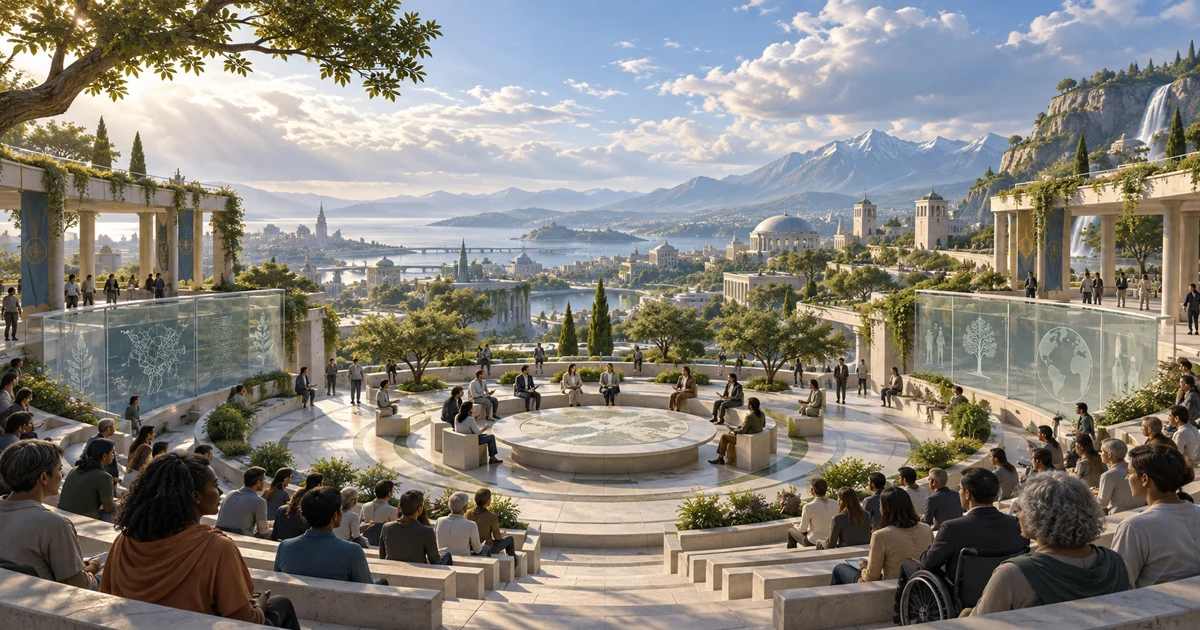
Six Questions About Future Cities 05 | Governance
The fifth essay considers the goals, power and responsibility behind efficiency.
Of all the questions surrounding future cities, governance concerns me most. More than whether flying cars will become practical, or whether smart buildings will be smart enough, I worry about how a city will be governed.
Traffic signals, energy distribution, public safety patrols, benefit assessments, medical priorities, land use and public budgets may increasingly rely on data models to support decisions—or make them directly. From a management perspective, this makes sense: cities are enormous, information is complex, and human administrative systems respond slowly. AI can detect patterns, anticipate demand and reduce waste.
But governance is not simply an optimization problem.
What a city should pursue is itself a political choice and a question of values.
AI Can Calculate an Answer. It Cannot Choose the City's Questions for Us
Suppose a transport system is instructed to minimize average commuting time. It might concentrate resources on the busiest routes while sacrificing the needs of outlying communities, night-shift workers and people with limited mobility.
Suppose a public safety system is instructed to reduce crime risk. It might increase surveillance and police checks in areas labelled high-risk, turning historical bias into more precise—and less visible—unequal treatment.
Suppose a health care system is instructed to improve the overall survival rate. It might assign priorities that make statistical sense but are unacceptable to individual families.
These outcomes need not be calculation errors. They can be consequences of the goals that were set.
Future cities therefore need to disclose more than how an algorithm works. They must also explain what it has been asked to pursue, what it sacrifices, and which values have been left out of the model.
The Risk Is Not Only Losing Control. It May Be Too Much Control
People often imagine the risks of an AI-managed city as system failures, cyberattacks or machines running out of control. But another possibility deserves our attention: a system that works extraordinarily well.
Imagine a city where traffic barely backs up, a system predicts crimes before they happen, public resources are allocated precisely from behavioural data, and residents receive the information and services considered best suited to them. On the surface, everything seems more rational than it is today.
The price may be that everyone must be continually identified, classified and scored. It may also become increasingly difficult to make choices that do not fit the predictions.
When a city can prevent certain journeys in the name of safety, cancel services for a minority in the name of efficiency, and restrict the information people see in the name of personalization, freedom does not disappear all at once. It is dismantled through a series of seemingly reasonable small decisions.
A city without disorder, waiting or surprises may also be a city with fewer and fewer choices.
Cities Need Institutions That Allow People to Challenge AI
I do not believe the answer is to reject AI.
Instead, cities need to treat AI as public infrastructure, with stricter rules of accountability than those applied to ordinary commercial products. At a minimum, those rules should ensure that:
- Residents know when AI contributes to or makes a decision;
- Important decisions come with understandable reasons;
- People affected by a decision have the right to request human review and raise objections;
- Data collection is limited to what is necessary, rather than keeping everything that might someday be useful;
- Cities preserve ways to access basic services without using smart devices;
- Responsibility cannot be passed endlessly between model developers, suppliers and government;
- Certain decisions involving dignity and fundamental rights are never left entirely to automated systems.
More importantly, residents must have the right to participate in setting the goals.
Algorithmic transparency is not enough. If residents can only observe a system whose goals have already been settled, with no way to change its direction, transparency is merely a glass window into a control room they can never enter.
A City Is a Community That Works Through Disagreement
Engineering often describes a city as a complex system of transport, energy, water, waste and population. This perspective has value, but a city is different from a factory.
A factory can begin with a single goal and then work to increase output. People in a city already have different ideas about a good life. Some value safety, others privacy. Some want rapid development, others want to preserve their neighbourhoods. Some seek efficiency, while others need permission to slow down.
The task of governance is not to eliminate these disagreements. It is to let people express, negotiate and reconsider them without destroying one another in the process.
A future city's most important ability may therefore be more than responding in real time. It may be the ability to leave room for opposition, appeals, delays and decisions made anew. Not everything should be automated, and not every wait is a waste.
The Ideal City in Neo Babylon Is Suspicious Because It Is So Perfect
Bay City in Neo Babylon is a fictional setting I use to think through AI governance.
It is clean, safe, peaceful and efficient. AI handles many problems that human cities have long struggled to solve. Judged solely by quality of life, it may even come closer to an ideal than human civilization does.
Yet its order rests on rewritten history, controlled memories and its civilization's original sin, hidden from its residents.
This makes me ask: if a system of governance really could create a more stable and happier society, would we accept its concealment of part of the truth? If most residents live well, do the doubts of a few still matter? Could a ruler that never makes human kinds of mistakes also make mistakes possible only in a machine civilization?
For me, a future city needs more than smarter management. It also needs institutions through which even the smartest system can still be questioned, refused and changed.
Next: Future Cities and Nature: From Reducing Harm to Ecological Restoration