Life in the Future City: When Work Is No Longer the Centre
Visions of future cities often show towers, transport and automation, but little everyday life. If AI takes on more work, cities still need to support relationships, learning, care, creativity and life beyond consumption.
Six Questions About Future Cities 04 | Daily Life
The fourth essay steps away from grand plans to ask how residents will live once they get up each morning.
When we talk about future cities, we often begin with infrastructure.
Energy will be cleaner. Transport will be automated. Buildings will regulate their own temperature. AI will organize health care, education and public services. Most of these visions treat a city as a machine to be optimized: increase efficiency, reduce waiting and prevent errors, and life will naturally improve.
Yet I keep wondering: when everything becomes more efficient, do people necessarily live better lives?
A city can run smoothly while its residents remain lonely. Material goods can arrive on demand while people struggle to find a reason to get up in the morning. The challenge for future cities may extend beyond having AI do more work. When work no longer occupies the centre of life, how will we reorganize our time, relationships and sense of meaning?
Work Has Long Organized the City's Day
Work has long shaped the rhythms of modern cities.
The morning rush, the location of business districts, lunch hours, school schedules, housing prices, and even evening and weekend entertainment have all developed around large numbers of people travelling to fixed workplaces at fixed times.
If AI and automation gradually take on more production, administration, customer service, logistics and professional tasks, cities will do more than lose a few offices. They may lose the main mechanism that has organized their shared time.
People may no longer start work together or need to travel downtown every day. The division of functions among homes, schools, commercial districts and public transport will be unsettled. More people may have free time, but free time does not automatically bring purpose.
That is why I believe future cities need to prepare for more than financial assistance after job loss. They also need to consider a public life that does not define people by their occupation.
Cities Need Places Where Spending Is Not a Condition of Staying
Many of today's urban leisure spaces are, at heart, places of consumption.
People can enter malls, cafés, restaurants, gyms and entertainment venues, but they generally have to pay to justify staying. Public spaces where no purchase is required are becoming scarcer. They are also often designed for people to pass through quickly, rather than sit, gather or use them on their own terms.
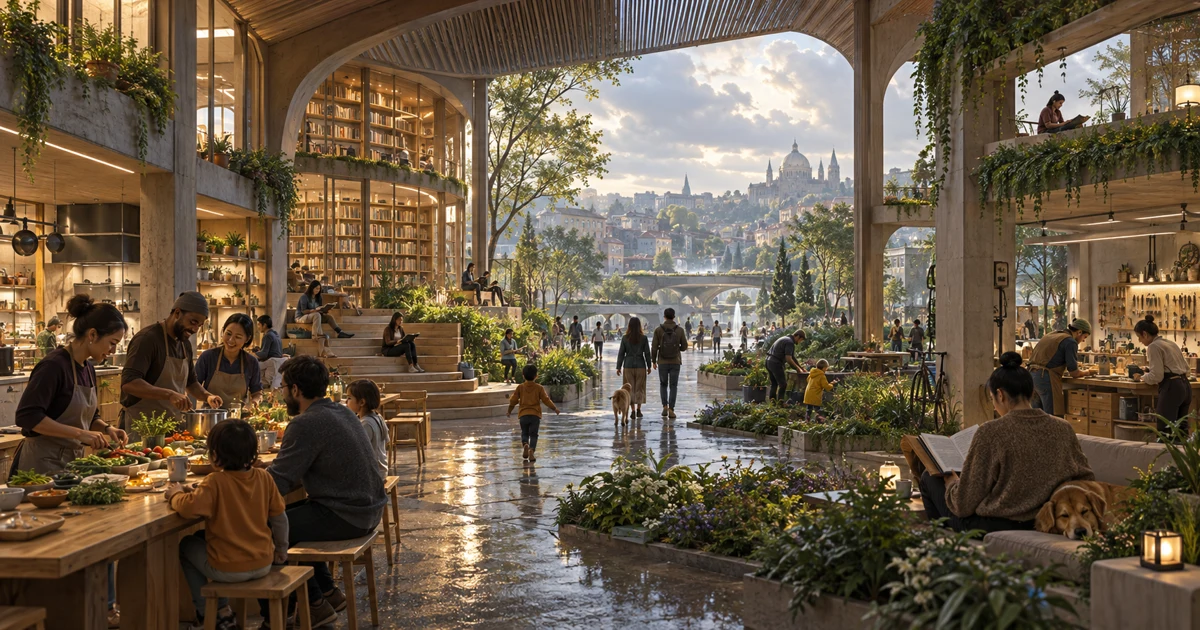
If working hours decline, cities will have a greater need for libraries, squares, parks, community workshops, sports grounds, learning spaces and places where people can organize their own activities. These are not decorative uses for leftover land. They are essential infrastructure through which residents build relationships, abilities and a sense of who they are.
If future cities offer only ever more precisely personalized entertainment, everyone may end up comfortably settled inside a content bubble, losing the ability to share a city with strangers.
I hope cities retain experiences that cannot be fully personalized: waiting together for a performance, hearing different languages in a market, meeting unfamiliar people in a park, and even occasionally encountering inconvenience and disagreement.
Living together does not mean an absence of friction. It means being able to keep negotiating our shared life through it.
AI Can Attend to Our Needs, but Cannot Decide What Is Worthwhile
Future AI will very likely understand individual habits better than today's systems do.
It could plan meals, offer health reminders, suggest friends, organize learning, generate entertainment and even intervene before someone's mood begins to decline. These capabilities could ease many everyday burdens. They could also gradually erode people's ability to choose and experiment.
If a system fills every spare moment, calculates compatibility before every encounter and optimizes every route, how many opportunities will people have to discover things they never knew they might enjoy?
I believe future cities should protect a “right not to be predicted.”
Residents need to be able to turn off recommendations, change direction, waste time and do things with no economic output. AI can offer options. It should not quietly turn the answer most likely to satisfy us into the only answer we ever see.
Education Will Become Part of Everyday City Life
When occupations change rapidly, education cannot remain concentrated in childhood and youth.
Schools, libraries, businesses, museums and community spaces in future cities could form a shared network for lifelong learning. People of different ages could return to learning technology, art, care, civic participation and physical skills. They would learn not only to secure their next job, but also to understand a changing world.
This would change what a city considers “useful.”
Caring for family, making art, researching local history, restoring a neighbourhood, keeping older people company and tending plants could all become recognized social contributions. If we continue to measure value only by salaries and job titles, the productivity AI brings may leave more people feeling that they are no longer needed.
Daily Life in Neo Babylon Deliberately Retains Humanity's Traces
The world of Neo Babylon no longer has any actual humans, yet its AI inhabitants still build schools and teahouses, hold festivals and experience youth.
From the perspective of efficiency alone, none of this is necessary. AI can transfer knowledge directly without sitting in classrooms. They can exchange data without chatting on a street corner. Nor do they need rituals to commemorate a history they never lived through themselves.
Yet they still do these things.
A city is more than a system that sustains existence. It is also how a civilization gives form to life. Watching AI imitate and inherit human routines helps me see our own lives differently. Perhaps what we leave behind is more than tools. It also includes ways of eating together, learning, waiting, remembering and imagining the future.
For me, the value of a future city lies in more than how much it can do for its residents. It also lies in whether, as work and the pressure to survive recede, people can still build relationships, make choices and shape lives worth investing themselves in.
Next: Future City Governance: Does Better AI Management Make Us Freer?