Future City Transport: Can We Reduce the Need to Travel?
Future transport must address more than speed and congestion. M.K. considers how transit, freight, automation and mobility privacy could give residents more time and choice.
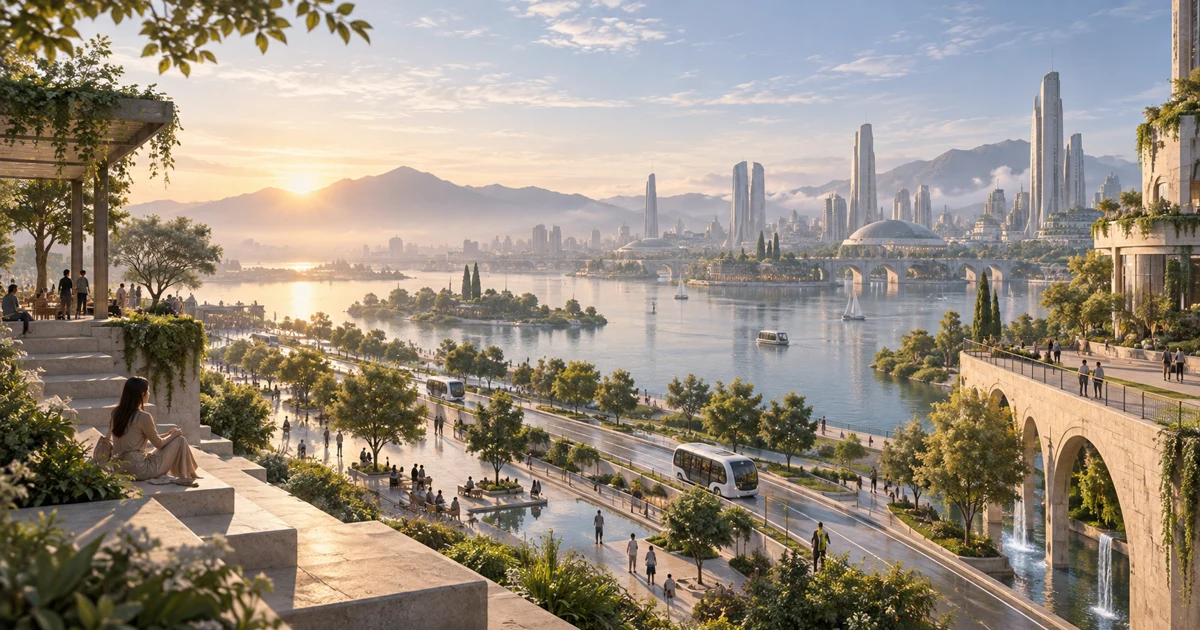
Six Questions About Future Cities 01 | Transport
This series begins with one of our most immediate experiences of a city: getting around.
When people imagine future transport, they still tend to picture faster cars, denser rail networks, driverless vehicles, flying taxis, or a few more minutes shaved off the commute.
But the question I want to ask is this: why must we spend so much time travelling every day?
Many cities today place housing, jobs, schools, health care, shops and recreation in separate areas, then require people to keep travelling between them. The city creates the distance first, then presents “overcoming distance” as progress. Wider highways, faster metros and smarter vehicles may all appear to improve transport, yet leave the daily necessity of rushing back and forth unchanged.
Giving People Their Time Back
I am not opposed to speed, nor do I deny that large cities need efficient transport. The problem is that we often treat kilometres travelled per hour as the main measure of progress. We rarely count how much of a person's life goes into commuting, traffic jams, transfers, waiting and searching for parking.
These are the questions that matter more to me:
- Can people meet their basic daily needs within a reasonable distance?
- Is public transit a more natural, reliable choice than a private car?
- Can older people, children and people with limited mobility travel independently?
- Can someone enjoy a full urban life without owning a car?
- Does technology reduce travel imposed by necessity, or simply enable people to work farther from home?
Ideal future transport does not necessarily mean putting everyone in a private car driven by AI. It means designing cities that no longer force everyone to depend on private cars in the first place.
Moving Goods Without Running Everyone Ragged
Future cities could move much of their freight through systems that take up less public space.
Goods, meals, waste, building materials and spare parts could travel by automated vehicle underground, through building service levels, or at designated times. Streets would no longer have to accommodate the conflicting demands of private cars, trucks, delivery vehicles, parking and pedestrians all at once. Space at ground level could return to walking, cycling, trees, markets and neighbourhood life.
The aim is not to eliminate movement, but to reconsider which kinds of movement take priority.
Machines are well suited to repetitive, regular transport over long distances. People should retain the freedom to stroll, explore, meet one another and change direction on a whim. When a city puts all its efficiency into delivering people to work, yet gives them no reason to linger in its streets, it remains little more than a vast production system.
Driverless Vehicles Could Just Make Traffic Jams More Efficient
I am hopeful about autonomous driving, but I remain sceptical too.
Giving every vehicle the ability to drive itself will not automatically clear the roads. If travel becomes cheaper, empty vehicles can circle on their own, and households still own several private vehicles, a city may gain more traffic, homes farther from daily destinations and greater urban sprawl instead of freedom.
Technology does not choose a city's direction on its own. It often amplifies choices already embedded in its institutions.
If policy continues to prioritize private vehicles, AI will make private vehicles more convenient. If a city gives priority to public transit, walking and shared space, AI may then help reduce the costs that transport imposes.
The Other Side of Convenience: A City That Knows Where You Go
Future transport will also become one of a city's richest sources of data.
Every boarding, transfer, walk and stop could be recorded to forecast demand, adjust routes and improve safety. Yet the same data could also be used to monitor residents, assign risk scores, charge different people different prices, or even restrict access to certain areas.
A discussion of future transport must therefore include rights as well as efficiency:
Who owns mobility data? Can residents choose not to be tracked? Is there a way to appeal when an algorithm refuses service? Can people without smartphones, credit histories or digital identities still move freely through the city?
A city with exceptionally smooth traffic, where nobody can keep their movements private, is not necessarily a more advanced city.
Remote Presence Will Also Change City Boundaries
Future mobility will extend beyond roads. Remote work, immersive communication, telemedicine and machines acting on our behalf may allow some activities to take place without our bodies arriving on site. But I do not think virtual connections will make cities lose their purpose. Instead, they will force us to distinguish journeys that are merely burdens left by our institutions from those made irreplaceable by physical presence, shared experience and a sense of place.
We can reduce commutes that a screen can replace. Better public spaces and transport should support the people and places worth visiting in person.
The Movement I Imagine in Neo Babylon
In the world of Neo Babylon, I deliberately avoid reducing future transport to ever more dazzling vehicles.
Once AI takes over logistics, energy and the coordination of city systems, what really changes is the reason for moving. Machines may deliver goods and carry out maintenance more precisely than people. But why do residents still step into the streets, enter schools, visit teahouses or travel between cities?
Because some journeys are about encounters, memories, rituals and the search for answers, rather than efficiency.
For me, progress in transport means more than arriving sooner. It also means reducing journeys that serve no necessary purpose yet are imposed by the city's structure, leaving residents with more time and more choice.
Next: Architecture in Future Cities: How Can Spaces Adapt as Life Changes?