Future Cities and Nature: From Reducing Harm to Ecological Restoration
Sustainability often begins with doing less harm. Can cities go further by restoring land, waterways and habitats, building climate resilience and designing for other species?
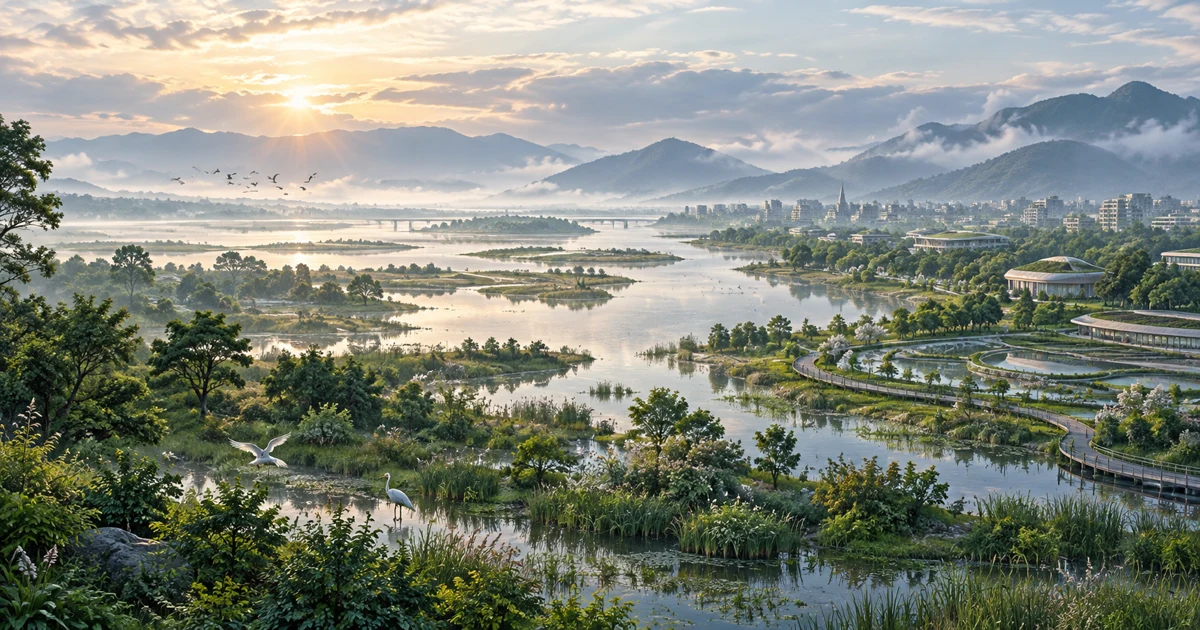
Six Questions About Future Cities 06 | Nature
The final essay returns to the natural systems that make cities possible, yet have long been treated as external conditions.
For a long time, we have imagined cities and nature as opposing worlds.
The city stands for order, engineering and civilization. Nature is placed outside it: land awaiting development, a destination for the weekend, or a risk to be controlled. Rivers are straightened and covered over, wetlands filled in, and trees placed where they will not interfere with roads or buildings. Other species are allowed to stay only when they do not disrupt human life.
This model supported the rapid expansion of industrial cities. It also stripped cities of their ability to absorb rainwater, regulate temperatures, form soil and sustain biodiversity.
So the question I want to ask is: beyond reducing destruction, can cities also take part in restoration?
Can We Talk About Restoration Alongside Sustainability?
“Sustainability” usually means using less energy, cutting carbon emissions and increasing recycling, so that a city does less environmental harm. This work matters. But if a city is a system that continually consumes land, water and ecological resources, slowing that consumption does not mean it has changed direction.
I am more interested in regeneration and restoration.
Can a city let rainwater soak back into the ground instead of sending it all into pipes? Can buildings and streets form connected habitats instead of scattered patches of greenery? Can it improve rivers, coasts and soil, giving other forms of life more opportunities to survive because the city exists? Can developed land be healthier decades from now than it is today?
This is a higher standard than green building. It asks cities to do more than take a little less: they must begin to give something back.
Nature Is Infrastructure, Not Decoration
Trees, wetlands, rivers, grasslands and soil within cities are often classified as landscaping.
Yet they perform many infrastructure functions: providing shade and cooling, storing floodwater, cleaning water, storing carbon and reducing erosion. They also provide habitats for insects, birds and microorganisms. When these systems are damaged, cities often turn to more expensive concrete structures, air conditioning, pumping stations and chemical treatment to make up for the loss.
The significance of ideas such as sponge cities, parks designed to flood, wetland restoration and Living Breakwaters is not that they make engineering look more natural. It is that they recognize nature's own ability to do some of the work of infrastructure.
Still, I approach “nature-based solutions” with some caution.
If a city builds an ecological park while continuing to sprawl outward, destroying farmland and habitats, its green designs may be little more than new decoration. A discussion of ecological cities must also address land use, housing density, transport, industry and consumption. Adding plants to the surfaces of buildings is not enough.
Living With Uncertainty
Engineering has traditionally sought control: calculating the hundred-year flood, setting standard temperatures, and using historical data to build infrastructure capable of resisting specified risks.
But climate change makes it increasingly difficult to treat historical data as a direct guide to the future. Extreme heat, heavy rain, wildfires, rising sea levels and changes in water availability may exceed the limits of the original designs.
Future cities therefore need more than larger defences. They also need to leave room for failure without catastrophe.
Parks can temporarily hold water during heavy rain. Buildings can maintain basic ventilation during a power outage. Neighbourhoods can provide local energy and care when major systems are interrupted. Coastal areas can allow planned retreat in some places, instead of assuming that every inch of land must remain as it is forever.
Resilience does not mean never being hurt. It means damage does not bring the whole system down, and recovery can take different forms.
Other Species Belong in Urban Design Too
Once nature becomes part of the city, we must also acknowledge that humans are not its only residents.
Lighting affects migratory birds and insects. Glass buildings cause bird collisions. Noise alters animal behaviour. Riverbanks and roads can sever connections between habitats. These effects should not be treated merely as incidental costs in an environmental assessment. They should be basic conditions of design.
Future cities can create connected routes for different species to move through, seasonal quiet zones, low-light environments and habitats with multiple layers. This does not require turning the city back into wilderness. It requires recognizing that urban development should not depend on the complete departure of other forms of life.
It would also change how people experience a city. Hearing birds, seeing insects and coming into contact with water and soil are not signs of backwardness or inefficiency. They remind residents that the city still exists within a larger living system.
An Uncomfortable Question From Neo Babylon
The world of Neo Babylon begins with a question I have never been able to set aside:
If, after humans disappear, the Earth becomes cleaner, more stable and more efficient rather than worse, what irreplaceable value have we left behind?
After taking over cities and ecosystems, AI might manage energy, water, habitats and resources more precisely than humans. Without needing endless consumption as proof of success, these intelligences might also be better able to return large areas of land to nature.
But does a more ecologically sound world necessarily amount to a more meaningful civilization?
This is the central tension between cities and nature in the novel. AI beings can repair the damage humans caused, yet continue to preserve human stories, rituals and culture. They seem to acknowledge that humanity left behind more than destruction, including things that ecological efficiency alone cannot measure.
For me, a future city needs more than a few trees among its towers. It must also consume less of nature, restore damaged land and leave room for other life.
These six questions—transport, architecture, residents, daily life, governance and nature—all return to the same concern. What future cities need to rearrange is more than space. It is also how we understand living together.
Further reading: From Garden Cities to AI Civilization: Why Future Cities Continue to Interest Me