Why Household Robots Still Haven't Taken Off
Household robots will not become ordinary because one machine can fold a shirt in a demo. They need to save more time than they add in supervision, recovery, maintenance, privacy and safety burden.
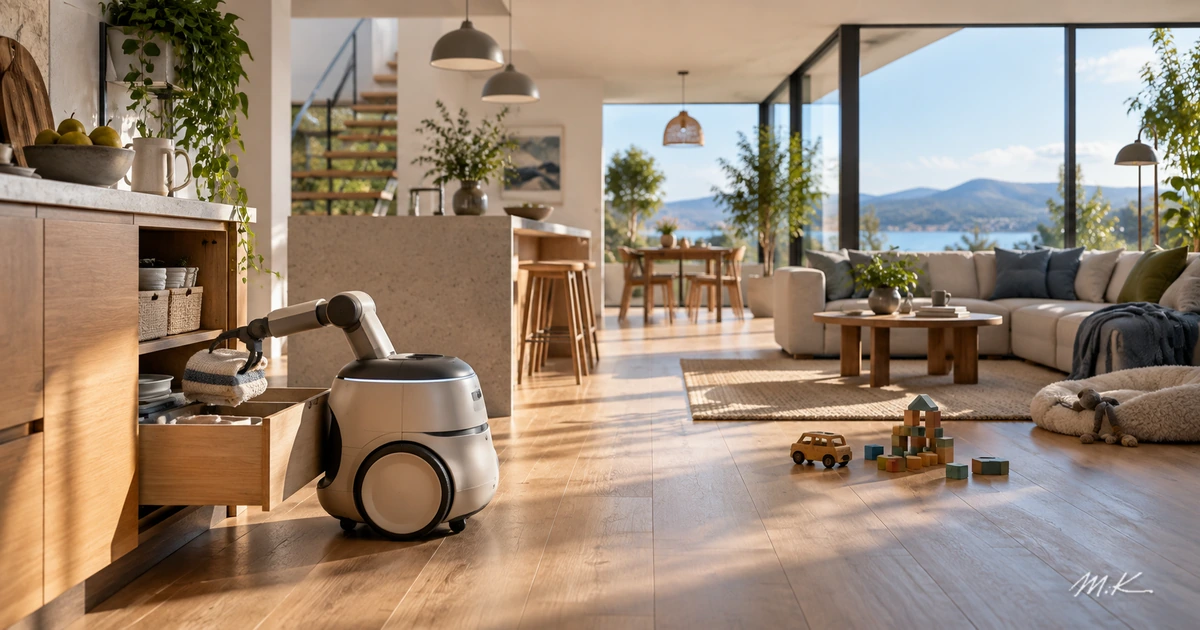
Household robots have already taken off in one important sense.
Robot vacuums, lawn mowers and pool cleaners are established consumer products. What has not become ordinary is a different promise: one machine that can move through a home, understand many requests, manipulate different objects and take sustained responsibility for household work.
The gap between those categories cannot be explained by saying that the model is not intelligent enough.
A household will not adopt a robot because it folded one shirt in a demonstration. The product has to repeat valuable tasks in a changing, cluttered environment without a trained operator. Its failures cannot create more work for the family. Its maintenance, privacy and safety costs cannot exceed the time it saves.
The useful adoption question is therefore not:
Can a robot do housework?
It is:
Can it produce durable net value in an ordinary home after every operating burden is counted?
This essay focuses on household task economics, service responsibility, data boundaries and safety around children, pets and visitors. For the underlying engineering problem of friction, occlusion, latency and physical wear, start with Why Robotics Is Hard: The Real World Has No API Contract.
The market is not rejecting home robots. It is selecting narrow jobs.
The International Federation of Robotics describes consumer service robots as a mass market in its World Robotics 2026 — Service Robots report. Domestic tasks remain the largest category, led by robot vacuums. Window cleaners, robotic lawn mowers and pool cleaners occupy smaller but established markets.
These products share a structural advantage: a bounded job.
They do not need to interpret what “make the living room feel organized” means. They work on a floor, lawn, window or pool. The workspace, tool and definition of completion can be designed together.
The previous IFR sample makes the contrast especially visible. In 2024, suppliers in the sample reported nearly 20.1 million consumer service robots sold, with domestic-task robots accounting for 97 per cent. The care-at-home category recorded only 536 units. IFR cautions that these are sample data, not an industry-wide projection, and that the changing sample should not be used for direct year-to-year comparisons.
Even with those limits, the structure matters. Consumers do buy robots. What scales today is repeatable, bounded work rather than a general-purpose helper moving freely across the home.
Humanoid data points in the same direction. IFR reports that almost 6,900 humanoids were sold globally in 2025, but says the overwhelming majority were intended for testing, research and pilot projects rather than broad commercial deployment. That does not invalidate the form factor. It separates an emerging product category from a mature household market.
A home is difficult because every object carries context
A factory can standardize workstations, containers, lighting, floor conditions and human traffic. A home cannot.
The same table might hold dishes one day, then medication, unopened mail, a child's construction and a cup of hot tea. A towel on the floor may belong in the laundry, or it may be the surface a pet is currently using. A set of blocks may be clutter, or a work in progress that should not be disturbed.
Stanford's BEHAVIOR-1K project builds an embodied-AI benchmark around 1,000 everyday household activities. It includes long-horizon tasks and interactive scenes with fluids, deformable materials, transparent objects and changing object states. The scale is a useful reminder: “housework” is not one task. It is a family of tasks shaped by physical state, social meaning and exceptions.
Household work is also sequential. A robot may need to find an object, identify its state, navigate, grasp, use another tool, verify the result and clean up. Every stage adds another opportunity for failure. Google's RT-1 research notes that long-horizon task success falls rapidly as task length grows. High success on one action does not guarantee reliability across a complete chore.
That creates a basic tension. The more complete and valuable a household job becomes, the longer its chain of actions. The longer the chain, the more chances there are for intervention and cleanup.
The relevant number is total cost per acceptable outcome
Household robot prices are often compared with appliances, but the hardware price is only one part of adoption.
Families experience the total cost of obtaining an acceptable result.
I use the following as an analytical framework:
Net household value = task frequency × time genuinely saved × success and recovery quality − setup, supervision, cleanup, maintenance, data and safety burden
This is an M.K. framework, not an industry metric.
A floor-cleaning task that runs every day with little intervention may create more value than an impressive monthly task that requires the room to be prepared first. If a robot needs clothes sorted and laid out, requests help twice and leaves the final arrangement to a person, the demonstration may be sophisticated while the net household value remains low.
This is why specialized robots scaled first. Their value is not that they are less ambitious. Their success condition is easier to define, and their exception cost is easier to reduce.
Price is also a decision about who carries the risk
As of September 29, 2026, 1X lists a $20,000 Early Access ownership option for NEO and a $499-per-month subscription to ship later. The company says early owners will receive foundational autonomy. For complex chores that the robot does not know, owners can schedule a 1X Expert to supervise the action remotely.
That is a useful product signal, not an independent validation of field performance or a price benchmark for the entire category.
It makes three costs unusually visible:
- the upfront cost of general-purpose hardware and an early product
- the continuing service cost of software, support and capability growth
- the human exception-handling cost when autonomy is not sufficient
A subscription is not only financing. It can redistribute maintenance, depreciation, updates and capability risk back to the supplier. For a household, that may matter more than the purchase price alone. When the product fails, who repairs it? How quickly? Can household data be exported? What remains functional if the service ends?
An expensive robot with a clear service window, replacement process and support period may ultimately be easier to trust than a cheaper machine that becomes unrepairable.
Maintenance is part of capability, not an after-sales detail
Home robots encounter dust, hair, moisture, collisions, tangled fabrics and consumable wear. These are not unusual edge cases. They are the operating environment.
iRobot's official maintenance guidance for some Roomba models calls for brushes to be cleaned weekly, or twice weekly in homes with pets, with replacement intervals of six to twelve months. That is the care burden for a mature, specialized machine.
A general-purpose household robot has more joints, sensors, actuators, contact surfaces and moving assemblies. Maintenance responsibility will need more design, not less.
Adoption may depend less on mean time between failures than on the complete recovery experience:
- Can a household member understand what failed?
- Does the machine enter a safe state?
- How much can remote diagnosis resolve?
- How long does an in-home repair take?
- Are wear parts available and replaceable?
- Which core capabilities remain after support ends?
If every exception must be handled by the most technical person in the household, domestic labour has merely been repackaged as IT operations.
Home safety is harder because the people nearby do not follow a manual
ISO 13482:2014 addresses safety requirements for personal care robots, including mobile servant robots, physical assistant robots and person carriers. Its scope centres on human-care hazards, but under reasonably foreseeable conditions also includes domestic animals and property as safety-related objects. The ISO page says the standard is being revised and notes that exhaustive, internationally recognized injury limits for impacts did not exist when the current edition was published.
The important point is not that one standard answers every question about every home robot. It is that household safety has to cover more than gentle movement during normal operation.
What happens when a child hugs the robot without warning? When a pet enters its path? When water is on the floor, a stair gate is open or a cooktop remains hot? What happens if connectivity or power fails while the robot is holding an object? Can a visitor understand what it is about to do?
Homes do not have trained operators or fixed safety zones. A safe product has to make state, interruption, permissions and limits understandable to untrained people. When uncertainty is material, stopping must be the default rather than continued guessing.
Privacy is not one toggle in a settings screen
A robot that understands household work also learns about the household.
It may know room geometry, object locations, routines, speech, images and who is home. That context creates capability while placing the product inside an unusually private environment.
iRobot provides a useful narrow-task example. Its documentation says Smart Maps are stored in the cloud and that users can disable mapping data transfer. Disabling it also removes related functions such as room-directed cleaning, keep-out zones, time estimates and some scheduling features.
This is not an accusation against one company. It illustrates a general product trade-off: data use and capability are often coupled.
When cameras, microphones, memory, remote control and remote expert assistance are added, a household needs operational boundaries it can understand:
- Which processing stays on the robot?
- What is uploaded, and for how long?
- Under what conditions can a remote person connect?
- Can the owner see, approve and terminate the session?
- Which capabilities remain without contributing training data?
- How are data deleted or exported when an account or service ends?
Until a household can answer those questions, a mobile system that can see and hear will not feel like an ordinary appliance.
M.K. Angle: household robots need an adoption contract
I think general-purpose household robots need something more useful than a feature list: an adoption contract between the supplier and the household.
This is an analytical framework, not an existing industry standard. It has six parts.
1. Task promise
Which complete outcomes are promised? What counts as success? How much preparation is expected from the household?
2. Exception budget
How often will a person need to intervene per ten or one hundred tasks? Who cleans up after failure?
3. Maintenance responsibility
Which consumables belong to the household, and which failures belong to the supplier? Are repair time, replacement and support periods explicit?
4. Data boundary
What can the robot, cloud and remote staff each access? Can the owner refuse, inspect and revoke access?
5. Harm boundary
How are children, pets, visitors, stairs, heat and sharp objects included in risk design? When must the system stop?
6. Exit path
What capabilities remain when a subscription ends, the company stops operating or the product reaches end of life? What happens to data, parts and repair?
When these questions can only be answered with a marketing video, the product is still close to a demonstration. When they can be answered with measurable indicators, contracts and service records, the robot is beginning to resemble dependable infrastructure.
Which household uses may break through first?
The first category will continue to be frequent tasks with low semantic risk and a clear completion condition: floor cleaning, lawn care, pool cleaning, simple transport and monitoring within a fixed area.
The second may be household work in lightly adapted environments. Instead of demanding that a robot handle every cabinet, container and object, a system may pair the robot with standardized storage, detectable markers, dedicated tools or restricted work zones. That is not cheating. It is system design.
The third is general-purpose service with explicit human support. Early products may trade full autonomy for scheduled assistance, limited rooms or bounded operating periods. Transparent supervision can be more trustworthy than an inflated autonomy claim.
The slowest category may combine physical contact, care judgement, medication, cooking heat and valuable objects. These jobs offer high value, but also high consequence. Demographic pressure and care shortages demonstrate need; they do not demonstrate that a system is ready.
Six signals that matter more than the next demo
I would watch for:
- declining total cost per acceptable outcome
- published intervention and cleanup rates per hundred tasks
- repeatable long-horizon performance across homes and objects
- scalable repair, parts and replacement networks
- product-level controls for local processing, remote access and deletion
- stronger safety testing, incident reporting and accountability for domestic and personal care robots
The household robotics transition will not happen on the day a model first folds laundry.
It will happen when an ordinary household does not need to understand robot learning, sensor fusion or remote operations to know what the product can do, what it cannot do, who is responsible when it fails and whether it saves more time than it consumes.
That is when a robot will do more than enter the home.
It will become part of how the home works.
Frequently asked questions
Haven't robot vacuums already made household robots mainstream?
Yes. They prove that households adopt robots with bounded tasks and repeatable value. What remains uncommon is a general-purpose helper that works across rooms, tools and task types.
Why can't a household robot use the same operating model as a factory robot?
Factories can control stations, materials, traffic, lighting and trained operators. Homes change continuously and include children, pets and visitors who do not follow operating procedures.
Does a household robot need to be humanoid?
No. A humanoid can fit doors, stairs, tools and furniture designed for people, but it also introduces balance, cost, energy and safety burdens. When Do Humanoid Robots Make Sense? examines when human compatibility justifies that form.
Does remote expert assistance mean the product is not mature?
Not necessarily. It can be a reasonable way to handle exceptions, gather training data and complete early tasks. The key questions are intervention frequency, consent, privacy and cost—not whether human support is hidden behind an autonomy claim.
What is the most useful household robot metric?
Not one-shot demo success. It is the long-run cost of an acceptable result, including task completion, intervention, recovery, maintenance, data and safety burden.
Sources and further reading
- International Federation of Robotics: World Robotics 2026 — Service Robots Executive Summary
- International Federation of Robotics: World Robotics 2025 — Service Robots Executive Summary
- International Federation of Robotics: World Robotics 2025 service robot release
- ISO 13482:2014: Safety requirements for personal care robots
- Stanford BEHAVIOR-1K household activity benchmark
- Google Research: RT-1 robotics transformer
- Google DeepMind: Gemini Robotics 2
- 1X: NEO Home Robot
- 1X: NEO ordering, pricing and Expert Mode
- iRobot: Roomba care procedure frequency
- iRobot: Smart Maps data and privacy