When Do Humanoid Robots Make Sense?
A human-shaped robot can fit spaces and tools built for people. Whether that benefit justifies two-legged mobility and complex manipulation depends on the task and its alternatives.
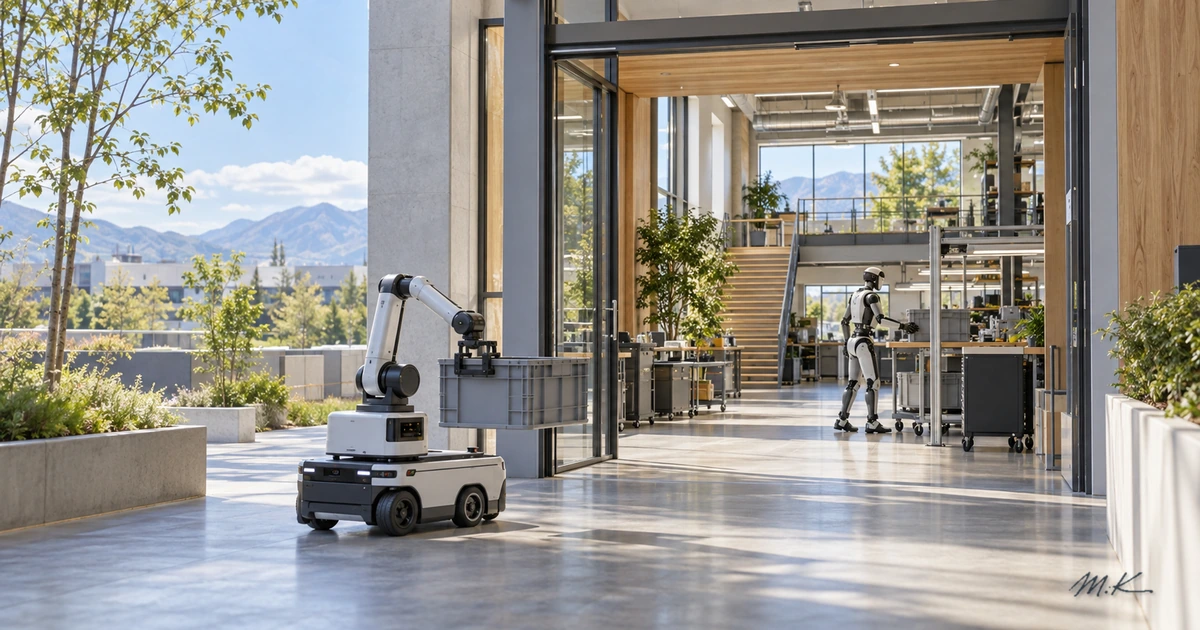
Imagine an established warehouse with aisles, totes, conveyors and workstations built around people. Should its operator buy a robot shaped roughly like a person, or use separate machines for moving boxes and inspecting equipment?
The useful question is not which silhouette looks more advanced. It is whether adapting the machine to the building costs less than adapting the building to a simpler machine. A humanoid may use more of an existing human workplace. Bipedal balance, manipulation, service and safety integration all come with costs. If a wheeled base or a dedicated gripper can do the job reliably, a human shape adds little by itself.
This essay is about the fit between body and workplace. Why Robotics Is Hard covers contact, latency and recovery; Why Household Robots Still Haven't Taken Off examines domestic value and service responsibility. Evidence from a warehouse should not be treated as proof that a general-purpose home robot is ready.
What does human compatibility actually buy?
Door widths, stair dimensions, shelf heights, handles, tools and workstation access are all consequences of designing for human bodies. When a facility cannot be rebuilt cheaply or shut down for long, a robot that can move through these spaces may avoid some retrofit costs.
Agility Robotics presents Digit 5 in exactly those terms: shelves, aisles, doorways and workstations, along with interchangeable end effectors. That is a vendor account of product design, not independent proof of productivity across facilities. GXO and Agility's commercial agreement establishes that at least one warehouse operation found this form worth deploying for defined work. It does not establish that every warehouse should do the same.
Compatibility is also not one capability. Passing through a door is different from safely operating a tool. Moving totes between stations is different from taking responsibility for an entire production flow. Mobility, reach, grasping, handoffs, recovery and work around people each need their own evidence.
Stairs and hands do not settle the design
Stairs are a common argument for two legs. They show why wheels may be constrained, but they do not prove that the machine needs two legs and two hands. ANYbotics describes ANYmal as a four-legged industrial inspector that can navigate multi-level plants and open grated stairs. It carries sensors for inspection rather than manipulating human tools. That is another way to fit an existing facility.
Some jobs do require manipulation at changing heights and angles. Even then, a robot's “hand” need not copy five fingers. Digit 5's interchangeable gripper design illustrates a hybrid choice: a human-scale mobile platform with task-specific contact tools.
In my view, “the human environment” hides four distinct constraints: doors, stairs, tools and workstations. A wheeled robot may handle the first; a quadruped may handle the second; a fixed arm may handle a stable station. A humanoid's option value grows when movement, tool use and assignments all change often enough that one specialized design no longer covers the work.
Specialized robots do not always demand a rebuilt warehouse
Humanoids are often compared with fixed automation that requires a facility redesign. That is too narrow a comparison. Boston Dynamics' Stretch combines a wheeled mobile base, arm and specialized gripper for case handling. The company describes trailer unloading and warehouse work within existing infrastructure. Stretch still requires integration, but it does not need human legs or hands.
That example raises the bar for the humanoid case. If the job is frequent and bounded, the objects are broadly similar, and the route can be managed, a dedicated machine can focus weight, power, control and maintenance on the actual work. On the other hand, building and maintaining a separate machine and workflow for every changing job can make specialization expensive.
The comparison should therefore cover the whole operation: site changes, end-to-end completion, human interventions, maintenance, downtime, safety validation and future changes in the task mix. This is an analytical framework, not an established industry formula.
What costs are hidden in a human shape?
Two-legged locomotion must continuously manage balance. Manipulating a load changes the centre of mass. More joints and sensors introduce more opportunities for calibration and service work. These are engineering cost directions, not proof that every humanoid consumes more energy or is less safe than every wheeled machine. Fair comparison requires the same task, site and safety requirements.
Safety cannot be inferred from a familiar outline. ISO 10218-2:2025 addresses the integration and lifecycle of industrial robot applications and cells. ISO/TS 15066 addresses collaborative industrial robot systems and their work environments. Neither is a universal certificate for all humanoid deployments. Mobile operation, proximity to people, falls, carried objects, stopping and recovery must be assessed in the actual operating context.
The International Federation of Robotics' 2026 service robot release notes impressive humanoid pilots, while describing current applications as mostly specialized and often dependent on teleoperation. It identifies training, maintenance, safety standards and the business case as barriers to broader adoption. That is a description of today's market, not a prediction that the form factor will fail.
M.K.'s test: can compatibility pay for the form?
I would frame the decision this way: Can the retrofit and integration costs avoided by fitting human infrastructure pay for the added control, energy, service and safety burden of a humanoid?
“Compatibility dividend” and “form-factor tax” are my analytical terms, not measured industry metrics. A procurement team could test them by asking:
- Which doors, stairs, tools and stations truly cannot be adjusted at reasonable cost?
- Does the work move frequently across locations, tools and task types, or repeat one narrow job?
- Can a wheeled platform, quadruped, fixed arm or mobile specialist deliver the same outcome?
- How often must people intervene, and what happens when the robot stops or fails?
- Is there a site-specific comparison of safety and total cost per acceptable outcome?
For stable, frequent, single-purpose work, specialization is usually the easier starting point to test. Where retrofits are difficult, jobs keep changing, and one robot can reliably serve multiple stations, a humanoid may earn its extra complexity. This is a conditional systems judgement, not a recommendation to buy any particular product.
The strongest evidence to watch next is longitudinal work across stations: actual task mixes, interventions per hundred tasks, failure recovery, service time and matched comparisons with non-humanoid alternatives. Those data would turn a debate about appearance into a decision about systems performance.
Frequently asked questions
What is the main advantage of a humanoid robot?
Potential compatibility with spaces, tools and workflows designed for people. Each task still needs testing; looking human does not establish operational compatibility.
Does a robot need two legs to climb stairs?
No. Four-legged inspection robots can navigate some industrial stairways. Terrain, payload, manipulation needs and safety conditions determine the right platform.
Are robot hands always more flexible than specialized grippers?
No. General-purpose hands may handle more objects but add control and reliability challenges. A dedicated or interchangeable gripper may suit repeatable tote handling better.
Should every warehouse consider a humanoid?
There is no evidence for a universal answer. Facilities differ in object types, routes, stations and changing assignments. Compare the entire workflow with mobile, fixed and other robot designs.
How can an operator tell whether a humanoid is worth the cost?
Compare total cost per acceptable outcome after site changes, completed tasks, interventions, energy, maintenance, downtime and safety integration. A purchase price or demonstration is insufficient.
Sources and further reading
- International Federation of Robotics: World Robotics 2026 service robot release
- Agility Robotics: Digit 5 and human-scale workspaces
- GXO and Agility: Digit warehouse deployment agreement
- Boston Dynamics: Stretch warehouse robot
- ANYbotics: ANYmal industrial inspection robot
- ISO 10218-2:2025: Industrial robot applications and cells
- ISO/TS 15066: Collaborative industrial robots