Who Will Pay for the Global GPU and Data-Centre Buildout?
A platform may finance an AI data centre without bearing its entire eventual cost. Follow cash spending, leases, depreciation, cloud contracts and electricity tariffs to see where the risk lands.
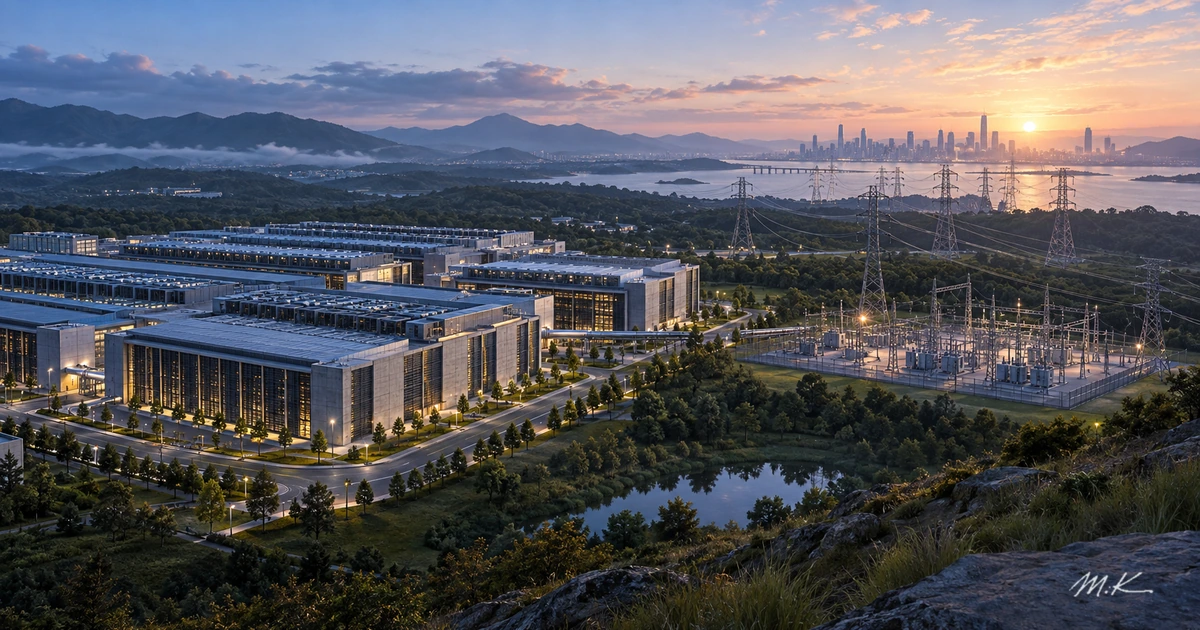
When a new data centre breaks ground, the cheque may be written by a cloud platform, a developer or its lenders. Years later, the costs may have moved through cloud bills to enterprise customers, through product prices to consumers, through disappointing returns to investors, or through an electricity tariff to other households and firms. The first payer and the final risk bearer are not necessarily the same person.
That is why an announcement about billions of dollars of GPU and data-centre investment does not answer the question in the title. A capital expenditure may be cash paid today. A lease may commit a company to payments over many years. A utility may build infrastructure before the customer it expects has begun taking power. And reported company spending often combines AI servers with ordinary cloud, networking and other facilities. Adding the headlines together would not produce a reliable global AI bill.
The more useful question is contractual: Who owns the asset, who has committed to use it, who cannot walk away if demand disappoints, and who pays for the grid that serves it? This essay is the third infrastructure chapter in The Long View on AI. The previous essay examined the total cost of an accepted AI outcome for an organization. Here the lens moves upstream, to the capital and public infrastructure required before any outcome can be sold. A cheap model call does not, by itself, show that the underlying buildout has earned a return.
Three ledgers behind one investment headline
The cash ledger records what is being paid now. Land, buildings, chips, networking and cooling have to be acquired before future customers generate revenue. In its second-quarter 2026 Form 10-Q, Alphabet reported US$80.6 billion in capital expenditure for the first six months of 2026, compared with US$39.6 billion in the comparable 2025 period. Its technical infrastructure includes servers, networking equipment and data centres. Amazon's filing for the same period reported US$96.3 billion in cash capital expenditure. Amazon says the spending primarily reflects technology infrastructure, most of that supporting AWS growth, and capacity for its fulfilment network. Neither figure is a pure measure of GPU or generative AI spending. They cannot simply be added and labelled a global total.
The accounting and commitment ledger stretches beyond the initial payment. An asset begins to be depreciated when it is ready for use; that expense then flows through future periods. Leases may fix future payments even if a facility has not opened. Alphabet's same filing reported US$13.6 billion in depreciation on property and equipment for the first six months of 2026, compared with US$9.5 billion a year earlier. It also reported US$85.2 billion in future payments for leases, primarily related to data centres, that had not yet commenced as of June 30. These are not cheques already written, nor can the lease total be added to capital expenditure without double-counting or confusing accounting categories. They show that expansion can lock in obligations far beyond a single earnings call.
The revenue and risk ledger asks whether customers will use the capacity at prices that cover electricity, operations, financing and depreciation. Cloud platforms can sell compute, storage, model access and software; their customers can then include those costs in their own products or operating budgets. Advertisers, subscribers and end consumers may indirectly fund part of the chain. But if servers are idle, prices fall faster than utilisation rises, or equipment loses value earlier than expected, the asset owner still faces its commitments. A platform with pricing power may pass some costs on. A platform competing for portable workloads may have to absorb more. The direction is observable in contracts and margins, not in a photograph of new GPUs.
Financing changes timing, not the need for a return
Large platforms may finance capacity from operating cash flow, debt, equity, leases or arrangements with independent data-centre operators. Each changes who advances funds and when payments come due. None automatically creates the future demand required to repay them. Similarly, a multi-year customer commitment can make a project easier to finance, but a booked contract is not the same as cash collected, profitable usage, or a guarantee that every part of a new campus will be occupied.
Amazon's second-quarter 2026 release illustrates why growth and recovery need separate readings. It reported higher operating cash flow for the twelve months through June 2026, while free cash flow moved to an outflow. The company primarily attributed that change to increased purchases of property and equipment, which it said mainly reflected AI investments. AWS was growing as well. Those facts establish a near-term cash-flow tension; they do not prove that Amazon's new capacity will succeed or fail. The answer depends on what it earns over the assets' useful lives.
Nor is “investors will pay” a complete answer. Shareholders bear the risk of lower returns, a falling share price or dilution; lenders bear repayment risk under their particular claims. Both may be rewarded if the facilities generate durable income. If demand does not arrive, their loss is not automatically transferred to all AI users. Debt covenants, leases, customer contracts and the platform's ability to set prices decide how far the risk can travel.
Depreciation makes this time mismatch especially visible. Cash can leave during construction, while depreciation expense appears after equipment enters service. A profitable existing business may finance the buildout for years, masking whether a particular new cluster has paid for itself. Conversely, a low current free-cash-flow number may reflect deliberate investment in assets that later earn substantial returns. Neither cash spending nor one quarter's profit settles the question. An honest assessment needs a time horizon consistent with the asset and access to revenue that can reasonably be linked to it—data that public filings rarely provide at the level of an individual GPU cluster.
The route from a cloud invoice to the end user
After building capacity, a provider tries to recover it through cloud compute, model APIs, software subscriptions and its own consumer products. Cost pass-through is not a straight line. Where customers can move their workloads and rivals have spare capacity, the provider may have to accept a lower margin. Where capacity is scarce, migration is costly or a contract reserves it for years, customers may bear more of the buildout risk. Those customers can then raise their prices, lower other spending, accept smaller profits or change the amount of AI they use. The final incidence cannot be read from the provider's capital expenditure alone.
For a reader comparing these businesses, I would ask three practical questions. Utilisation: how much of the installed capacity is usefully occupied over time? Unit economics: after power, networking, maintenance and depreciation, does the associated revenue still support a return? Bargaining power: which party can refuse a price increase or leave a reservation? Public accounts usually reveal company-wide spending and segment-level revenue, but not the negotiated discount or complete cost of a particular workload. That missing evidence should limit the confidence of any claim about the “real” payer.
The distinction also matters when model prices decline. Better hardware, scheduling, caching and software can reduce the cost to serve each request. The provider might share the gain with customers to increase demand, retain it as margin, or use low prices to win a market. Meanwhile, land, buildings, leases and grid connections still carry obligations. A cheaper request can therefore coexist with a growing capital bill. The earlier discussion of cost per accepted outcome helps a customer decide whether AI is worth adopting. It is not a substitute for testing whether the provider's capacity investment is being recovered.
The fourth ledger belongs to the electricity system
A data centre pays for electricity it uses, but that bill is only one part of the grid question. Connecting a very large new load may call for substations, transmission upgrades or additional generation. If a utility builds for a forecast customer that never arrives, who pays for the stranded capacity? If grid investments are recovered through rates shared across customers, households and small businesses might absorb costs they did not cause. If the large customer provides security, pays for dedicated works and commits to minimum charges, that risk can be reduced. These are possible outcomes under particular tariffs, not a claim that every data centre is currently subsidised by neighbours.
The U.S. Department of Energy's technical brief on large-load rate design identifies fair allocation of system costs, protection against stranded assets and reliability as central issues. Virginia offers a concrete example. Its State Corporation Commission approved a new GS-5 rate class for very large customers, including data centres, effective January 2027. Certain customers must pay at least 85% of contracted distribution and transmission demand and 60% of generation demand, even where actual use is lower. That is a deliberate way to allocate some forecast risk to the customer that prompted the expansion. It is not a claim that every grid cost has been assigned to the data-centre operator, or that the protection is already in effect in October 2026.
At the federal level, the U.S. Federal Energy Regulatory Commission's large-load interconnection proceeding asks, among other things, who should pay for network upgrades and whether such payments should later be credited back. The International Energy Agency notes that data centres can be built faster than the wider power system can plan and expand, creating local connection constraints. Taken together, these primary sources show why the electricity consumer, the grid investor and the bearer of unused-capacity risk may be different parties. The exact split is a tariff and contract question, and it varies by jurisdiction.
Government can also contribute to research compute, electricity infrastructure or procurement. Such spending may produce public benefits, including scientific access or grid resilience, but a public benefit does not follow automatically from a subsidy. To say taxpayers “paid for” a particular private project, one must examine the actual budget, loan or guarantee, who receives access or ownership, and who covers a failure. There is not enough consistent evidence to turn these arrangements across countries into one defensible global taxpayer figure.
Follow the commitment that cannot be cancelled
My working test is simple: if demand falls, who cannot leave? This is an analytical tool, not an accounting standard. If a provider owns a cluster and customers can stop buying by the hour, the provider and its capital providers retain much of the idle-asset risk. If a customer signs a non-cancellable, multi-year capacity agreement, some risk has moved to the customer. If a utility expands the network without adequate minimum-payment protection, part may reach other ratepayers. The answer changes with the contract; it cannot be inferred from the size of an announced project.
Three scenarios make the test concrete:
- Demand fills the capacity. Providers recover depreciation from sustained usage, customers receive value they can measure, and dedicated grid work is repaid under transparent terms. The upfront investors took risk, while people choosing the services ultimately fund most of the cost.
- Compute prices fall faster than usage grows. Customers benefit, but the margin available to asset owners narrows. Shareholders and lenders may absorb an investment mismatch. A customer with a minimum-use obligation may still pay for unused capacity.
- Construction runs ahead of demand or grid connection. Leases, financing and equipment costs remain due. Depending on the safeguards, losses may rest with developers and large users or be spread through utility rates. This is a stress case for reviewing commitments, not a forecast of a market crash.
Over the next 12 to 24 months, I would watch cash capital expenditure alongside depreciation; whether usable capacity growth has a credible counterpart in cloud revenue; how long-term leases and purchase commitments are disclosed; and whether large-load tariffs tie the cost of dedicated grid work to its beneficiary. Evidence of sustained revenue after operating costs and depreciation, together with tariffs that protect other customers, would weaken concern about cost shifting. Rising commitments without comparable utilisation, unit margins or tariff transparency would strengthen it. Those are conditions under which this interpretation can be revised rather than a predetermined verdict on AI investment.
There is no single final payer. Platforms, enterprise customers, investors, consumers and taxpayers can each carry a share under different arrangements. The useful question is more precise: Who receives the revenue, who can change the price, who can leave, and which bill remains payable if the expected customer never comes?
Frequently asked questions
Does a jump in capital expenditure mean the AI investment is losing money?
No. It records resources committed to assets before their future revenue is known. It shows funding needs and exposure, not a return on investment by itself.
Do ordinary electricity customers inevitably pay for data centres?
No. Data centres pay for electricity, and the treatment of new grid works depends on local tariffs, minimum payments, security and connection agreements. Virginia's GS-5 design is one example of an attempt to limit cost shifting.
Does a cloud customer pay for the full GPU buildout?
Not necessarily. Customer fees can recover part of the investment, while the provider may retain idle-capacity, price-competition and depreciation risk. Long-term minimum purchases can transfer some of that risk back to the customer.
Why not add up the announced spending of major technology companies?
The reporting scopes differ and can include non-AI cloud equipment, logistics, networking and leases. Parts of the same supply chain may be counted more than once. Without a consistent boundary and de-duplication, the total would mislead.
Which public figures deserve to be read together?
Read cash capital expenditure, operating cash flow, depreciation, lease and purchase commitments, plus the related business's revenue and margin. For the grid, read the local tariff and minimum-payment rules. No single headline investment figure identifies the eventual payer.
Sources and further reading
- Alphabet: second-quarter 2026 Form 10-Q
- Amazon: second-quarter 2026 Form 10-Q
- Amazon: second-quarter 2026 earnings release
- U.S. Department of Energy: electricity rate design for large loads
- Virginia State Corporation Commission: GS-5 large-load rate class
- Federal Energy Regulatory Commission: large-load interconnection proceeding
- International Energy Agency: Energy and AI, electricity demand