If Everything Is Getting Cheaper, Why Does It Still Feel Hard to Get By?
A washing machine on sale reveals where Japanese brands and Chinese manufacturers cooperate, where they compete, and who pays when prices fall.
← Back to the Asia Outlook 2027 series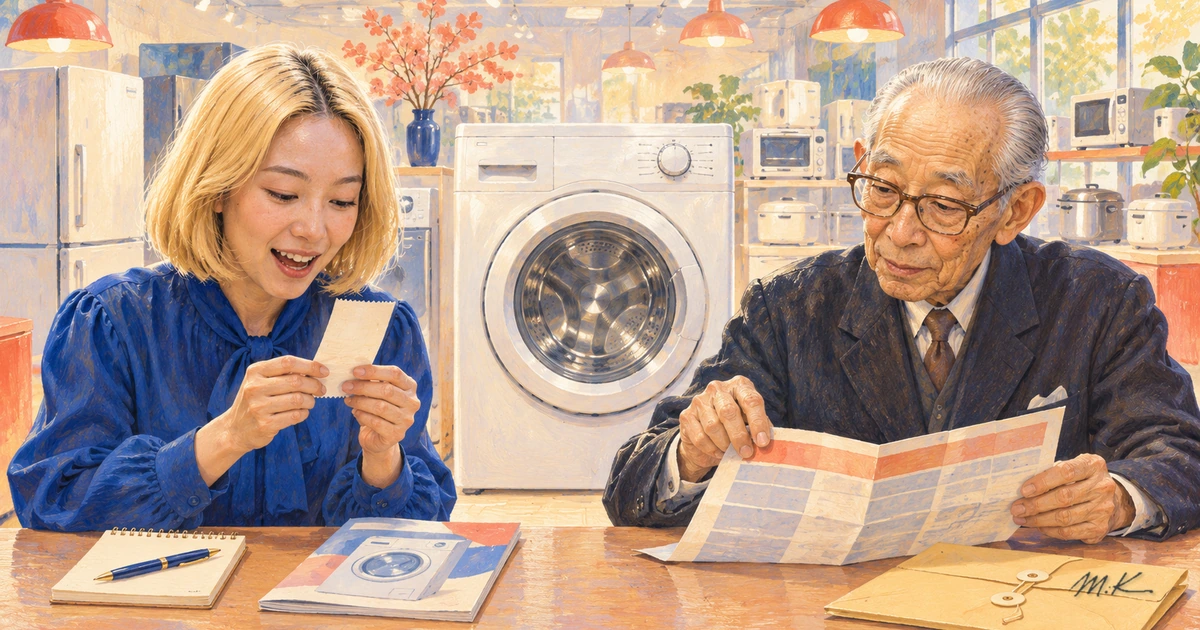
Imagine Dorami at the checkout, folding the receipt for a discounted washing machine. That same day, a small parts maker gets a notice asking it to cut its price again next quarter. Dorami works out which bill the savings will cover. The owner opens a spreadsheet and wonders whether to put off the raise promised to staff. The two sides are closer than they look. Factory workers buy washing machines too.
What did Matsushita want to make cheaper?
In 1932, Konosuke Matsushita used tap water to explain what he thought manufacturing was for. If everyday goods could be made in abundance and sold at prices ordinary people could afford, life could improve. I would add a question. Did the washing machine get cheaper because it takes one fewer step to assemble, or because a supplier is earning less for the same work? Either way, the shop can print the same sale tag. What happens next quarter can be very different. Panasonic's history of its founder
When a factory redesigns two parts as one, the buyer, brand and supplier can share the savings in materials and assembly time. If a brand simply asks for a lower bid, the work still has to be done. The supplier may postpone new equipment or keep fewer spare parts in stock. The buyer learns what the original receipt really covered when the machine stops working.
Customers in one deal, competitors in the next
The Japan External Trade Organization analysed responses from 791 Japanese-affiliated companies operating in China. Chinese companies were their main competitors, and Japanese firms pointed to performance and quality as ways to avoid competing on price. Yet more than six in ten respondents expected an operating profit in China in 2025. A Japanese company may want a second source for a key part while also choosing to keep making and selling products in China. Both decisions can make sense for the same business. JETRO survey on Japanese companies operating in China
Japanese brands want customers to have a reason to pay more and fewer shipments to depend on a single supplier. Qualifying a second supplier takes time and money, and keeping spare parts available takes inventory and staff. Chinese firms can win more orders through better manufacturing and sell their own brands and services overseas. But a parts maker that lowers its quote every year to keep a Japanese customer has to find money somewhere for engineering and after-sales support. That is the difficult bargain. Both sides need some of what the other can do. Both want to keep the part of the business that gives them a say over price. Japan's 2026 trade white paper summary
The conflict gets sharper around sensitive technology. In 2023 Japan announced that it would add 23 types of high-performance chipmaking equipment to export controls covering all destinations. In January 2026 China barred exports of dual-use items to Japanese military users, for military purposes and for other end users or uses that would enhance Japanese military capabilities. The measures differ in scope. They tell us little about the price of a washing machine. They show a separate tension. Japan wants to earn from exports while controlling where critical equipment goes. China wants access to production technology while restricting some trade with Japan on security grounds. A company that wants to keep trading has to pay to prepare for the possibility that the terms change. Japan’s Ministry of Economy, Trade and Industry · China’s Ministry of Commerce, Announcement No. 1 of 2026
A subsidy can get you to buy today. What about the next machine?
China's 2026 appliance trade-in policy subsidizes six categories of products meeting top-tier energy or water efficiency standards at 15 per cent of the sale price, capped at 1,500 yuan per item. It can put a more efficient model within reach for someone already replacing a machine. It can also move a purchase from next year into this one. Official figures for retailers above the reporting threshold show that sales of household appliances and audiovisual equipment rose 1.9 per cent year over year in September 2026 but fell 4.9 per cent over the first nine months. A stronger month can sit inside a weaker year to date. The figures alone cannot tell us how many additional purchases the subsidy brought about. China's trade-in policy · National Bureau of Statistics, September retail figures
Japan has its own reasons to wait. The Bank of Japan's October outlook expects the link between rising incomes and spending to strengthen from fiscal 2027, and also flags upward pressure on energy and durable-goods prices. A household can get a raise and still wait to see what is left after the electricity bill and other essentials. A Japanese brand asking buyers to pay more for a machine that lasts has to show them which parts will be available, what the warranty covers and what a repair might cost. That is a harder sale to a household watching this month's cash.
In 2027 I would check two sets of books. First, will households buy at an ordinary price after the promotion ends? Second, when shipments rise, can suppliers still improve their factories, can workers get a raise, and can buyers get a broken machine fixed? If prices fall and those things improve together, competition has taken a real cost out of the product. If the savings end at the checkout and the whole machine has to be replaced a few years later, I would do the math again. Bank of Japan, October 2026 outlook
Would you buy a washing machine at 30 per cent off, or pay more for one with clear terms for spare parts and repairs?
Listen to the conversation
Listen to Who Earns Less When Prices Fall?. In this Mandarin episode, M.K., Dorami and a dramatized Konosuke Matsushita trace the cost of a discount through Japanese and Chinese manufacturing.