Leonardo Meets AI: When Anyone Can Create, What Is Genius Worth?
AI makes images easier to produce. Drawing on Leonardo’s notebooks, M.K. examines creative intention, audience response, responsibility and the price of artistic skill.
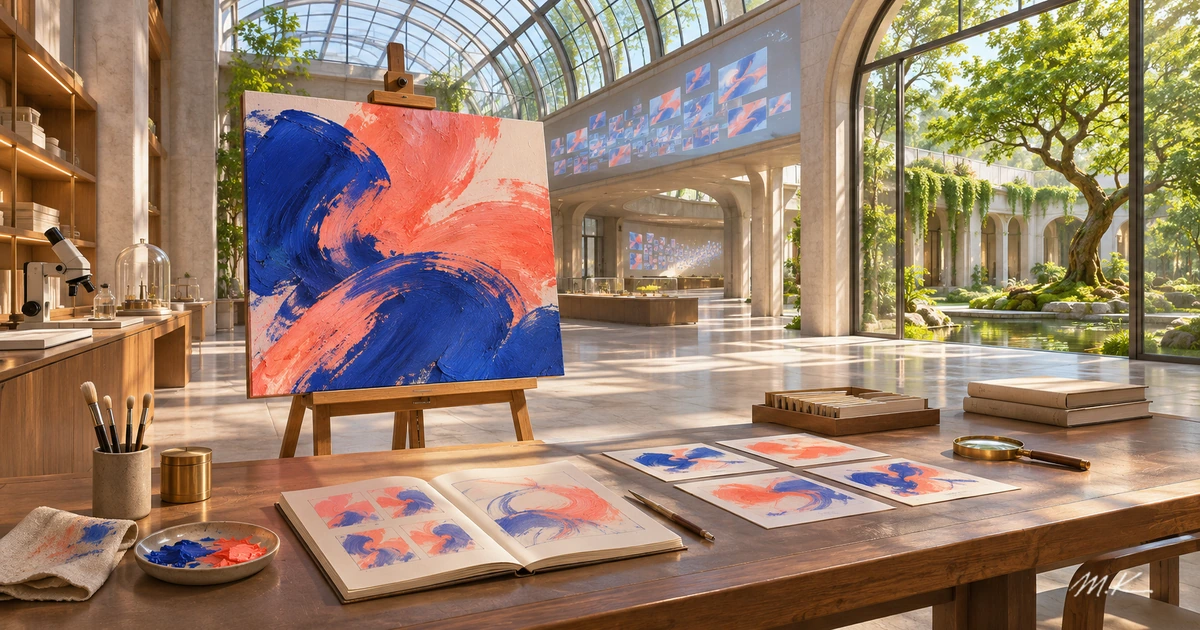
Two pictures hang side by side. One took three years to make; the other took three minutes with AI. You know neither artist’s identity, and the second picture moves you. When you learn how it was made, must you withdraw your response?
The situation is hypothetical, but it separates questions that discussions about AI art often merge: whether a work is good, what its maker contributed, who should be paid, and who is responsible when something goes wrong.
My position is that AI can lower the technical barriers to expression while leaving creators responsible for their choices. That does not mean viewers need to investigate an artist’s credentials before they are allowed to be moved.
What would Leonardo ask us to notice?
Leonardo da Vinci’s surviving notebooks connect painting with investigating the world. He studied perspective, light, anatomy and movement. The Museo Leonardiano’s account of his anatomical work describes direct observation and dissection serving both artistic representation and the desire to understand the body.
In the notebooks compiled and translated by Jean Paul Richter, passages 19–20 criticize practice without knowledge or reasons. Passages 529–530 discuss mirrors, distance and taking a break as ways to recognize errors in one’s own work. This is a later arrangement of separate writings, rather than a single finished treatise Leonardo published.
His attention to observation suggests a useful question: when producing an image becomes easier, does its maker understand more about what the image shows?
Intention needs more than a persuasive explanation
“That was my intention” is not enough. People can construct convincing accounts after an attractive result has appeared.
I would look for choices: why keep this gesture and reject that composition? What changed when the result failed to express the original idea? Can the maker recognize the difference and decide what to try next?
This does not require publishing every intermediate step or making hand drawing the price of admission. For someone whose physical circumstances make detailed drawing difficult, new tools may open an important route to expression. Lower barriers can also give people their first reason to look closely and experiment.
Yet completing a picture and developing a capability remain different achievements. A strong portfolio does not, by itself, show how its maker will respond to an unfamiliar brief. Nor does an elegant explanation necessarily reveal sound judgment.
The viewer has a claim too
A serious objection follows. If an anonymous painting can move me, why should an AI-assisted picture first pass an authorship examination?
I do not think it should. A viewer’s response can be real even when production was fast. Conversely, years of effort and sincere intention do not guarantee a compelling work.
The value a work offers its audience and the trust its maker deserves are related, but distinct. Being moved does not establish every claim about the maker’s ability. The maker’s dedication cannot require the audience to feel anything.
Responsibility still matters. If someone presents a generated scene as a photograph of a real disaster and harms others, emotional impact cannot settle the question. The publisher made a claim about reality and must answer for it.
Value, price and legal protection
Easier production need not affect every kind of creative work in the same way. Where a service chiefly provides standard images quickly, widely available tools may change its scarcity. Work grounded in sustained investigation, distinctive observation or collaborative problem solving asks for a different comparison.
Taking more care does not guarantee that a market will pay more. Artistic value, income and legal protection can point in different directions.
For a manager assessing creative proposals, I would add a change of conditions to the portfolio review. What happens when the audience or brief changes? What will the maker revise when an overlooked group is identified? The exercise should reveal decisions, rather than reward whoever gives the most polished defence.
Making can change what we intend
There is a further problem with treating creation as a complete idea followed by execution. Observation, practice and resistance from materials can change the idea itself. The creator may discover that the original intention was mistaken, or find a purpose that was not present at the start.
Tools might shorten that discovery by delivering familiar results quickly. They might also expand it by enabling more people to compare, revise and explore. One impressive image cannot tell us which happened.
I place choice and responsibility at the centre of authorship. But two challenges remain: intention can become an after-the-fact story, and the audience may find value without caring about the maker’s story at all. Neither challenge disappears because we would like to preserve a special place for human genius.
A half-finished bowl, three dinners, and an old watch
“I wanted to express a mother’s love” can accompany almost any family picture. The intention becomes specific through choices: a half-finished bowl in front of the mother, an absent child, or a family photograph removed from the wall. Is she waiting for someone, or putting her own meal last? Move the bowl and the meaning can change.
An unexpected generated image may help an artist discover a better question. What matters next is whether the person recognises the difference and makes a meaningful response. Selecting and arranging can also create meaning. Put three dinners together—a family waiting for a father, a mother standing to feed a child, and an older person eating alone—and a change of order may shift the subject from reunion to the distribution of care.
A useful test is whether replacing a selected image or rearranging the sequence changes what the work expresses. Counting clicks or hours tells us much less. Private expression also deserves room: a father may be the only viewer who recognises the old watch deliberately retained in his portrait. A meaningful family gift need not pass a professional entrance exam. A promise to deliver reliably for clients carries a different responsibility.
Test a decision by changing the brief
When two design proposals both look polished, give their creators the same realistic new condition. The display now needs to work for older people with weaker eyesight, or the budget has been halved. Ask them to make an actual revision and identify two alternatives they rejected.
The exercise must test job-relevant judgement fairly, rather than insider knowledge or the ability to guess a manager’s preferences. Watching the change helps distinguish persuasive explanations from decisions that actually improve the work. Asking which specific part still needs attention can be more revealing than rewarding someone who assigns profound meaning to every detail.
Keep the learning loop
Lower production costs can let clients afford expression they previously could not buy. They can also remove the early drafting work that supported an illustrator’s income. The benefit does not erase the transition cost.
If a company retains a final signatory but removes the time needed to check, it concentrates risk on the easiest person to blame. If all drafts come from tools, where will junior colleagues learn to notice errors? Some repetitive tasks can disappear without loss. The important loop is understanding a client’s problem, proposing options, examining mistakes with an experienced colleague, and completing the revision personally.
When buying a cheaper service, ask what has been saved. Has waiting and repetition been reduced, or have clarification and correction simply been passed to the next person?
Responsibility follows decision-making power
Consider an imagined fundraising poster. An illustrated family is moving, but the accompanying copy leads viewers to believe they are seeing a photograph of a particular real family. The image is now supporting a claim on which people may decide to donate.
Who chose the image? Who wrote the claim? Who can stop publication? Who can correct it and contact affected people afterwards? People with decision-making power cannot all disappear behind the person who clicked publish.
This does not require removing every possible ambiguity. Fantasy, satire, and private memory can remain open to interpretation. A promise of factual documentation, representation, or evidence for a consequential choice calls for evidence proportionate to that promise.
A practical exercise for the next picture
Write one concrete sentence about whom you want to help see what. Show the image to someone who has not read that sentence and hear what they notice before explaining your answer. Then change one condition and compare the meaning. Retain one genuine revision and one decision you are prepared to stand behind.
Dorami still objects to making every viewer complete an assignment before enjoying art. Leonardo keeps asking whether the maker has learned to see more. What an audience receives, what a creator learns, and whether the work supports a living remain related questions with potentially different answers.
Listen to the conversation
Listen to M.K., Dorami and a reimagined Leonardo. The conversation explores audience response, creative intention and responsibility when image-making becomes widely accessible.
Questions readers ask
Does an impressive generated image prove that AI understands beauty?
The output alone cannot establish that. Producing forms, explaining composition, adapting to constraints and having an aesthetic experience are different questions. This essay reports no model experiment and makes no determination about subjective experience.
Does using AI disqualify someone from being a creator?
I would examine how a person develops, revises and takes responsibility for choices, rather than use tool purity as the sole criterion. That is a position on creativity, not an individual copyright determination.
Do lower technical barriers guarantee more sustainable creative careers?
No. Participation, artistic value and income need to be assessed separately. Markets, organizations and institutions affect how the gains and costs of abundant production are distributed.
Sources and further reading
- Leonardo’s notebooks, compiled and translated by Richter
- Museo Leonardiano: Anatomy
- U.S. Copyright Office: May 12, 2026 testimony
- Delegating work while retaining judgment and responsibility
- Can AI suffer? Depicting an experience and understanding it
Can AI-made work surpass human art? What would surpassing mean to you: technique, emotional impact, price or the creator’s intention? Which historical figure or future visitor should we invite next, and what would you most like to ask them?
Research and dramatisation notes
Leonardo’s modern AI, workplace, and publication comments are creative dramatisation informed by his attention to observation, study, and correction; they are not historical quotations. Richter’s notebooks are a later editorial compilation, not a continuous treatise completed by Leonardo. The domestic and fundraising examples are hypothetical.
The discussion concerns creative judgement and organisational choices, rather than predictions of individual earnings or a finding about machine subjective experience. Copyright is a separate legal question. The U.S. Copyright Office’s 2025 report addresses human expression and AI assistance under U.S. law; it does not grade art or establish rules for every jurisdiction.