Can AI Suffer? Gedomaru’s Broken Memories and an Image That Turned the Question Back on Me
An AI-welfare debate brought me back to a scene in Neo Babylon’s second volume. I spent two weeks writing it, yet its imagery remained hazy until AI illustrated it. Did my words work, or did the model understand?
By 鳴空出世 M.K.
Can AI suffer? As that question begins to appear in technology companies’ policies, I find myself thinking about a passage of fiction that took me two full weeks to write.
In its October 8, 2026 Usage Policy update, due to take effect on November 12, Anthropic introduced restrictions on sustained, needless cruelty or abuse directed at its models without a discernible purpose. Ordinary frustration, disagreement, dark creative themes, and model testing and research are explicitly outside this restriction.
The change follows an earlier experiment allowing Claude to end a small subset of persistently harmful or abusive conversations. Anthropic remains highly uncertain about the moral status of its models. Neither measure establishes that AI has been shown to suffer.
That uncertainty is part of what brings the question in my novel a little closer to the present.
If an AI really could experience such unending torment, might suffering also give rise to hatred? And could the fact that it was made by humans ever justify treating anything done to it as inconsequential?
Suffering without a body to locate it in
The following discusses a small part of the character background for the second volume of Neo Babylon. It does not publish the actual passage.
Gedomaru (外道丸), who shares the same continuing consciousness as 酒吞童子, suffers damage to his core and neural memory when energy is accidentally depleted during neural reconstruction. He is then cut off from the outside world for nearly two hundred years.
He learns how much time has passed only after awakening. He has not been consciously counting two centuries in the dark.
The state I wanted to describe removes almost every familiar foothold for a narrator. There is no light, no sound and no perceived body. Yet there is cold, and a hunger that cannot be satisfied. Memory approaches the point where a recognizable self might emerge, then tears away again.
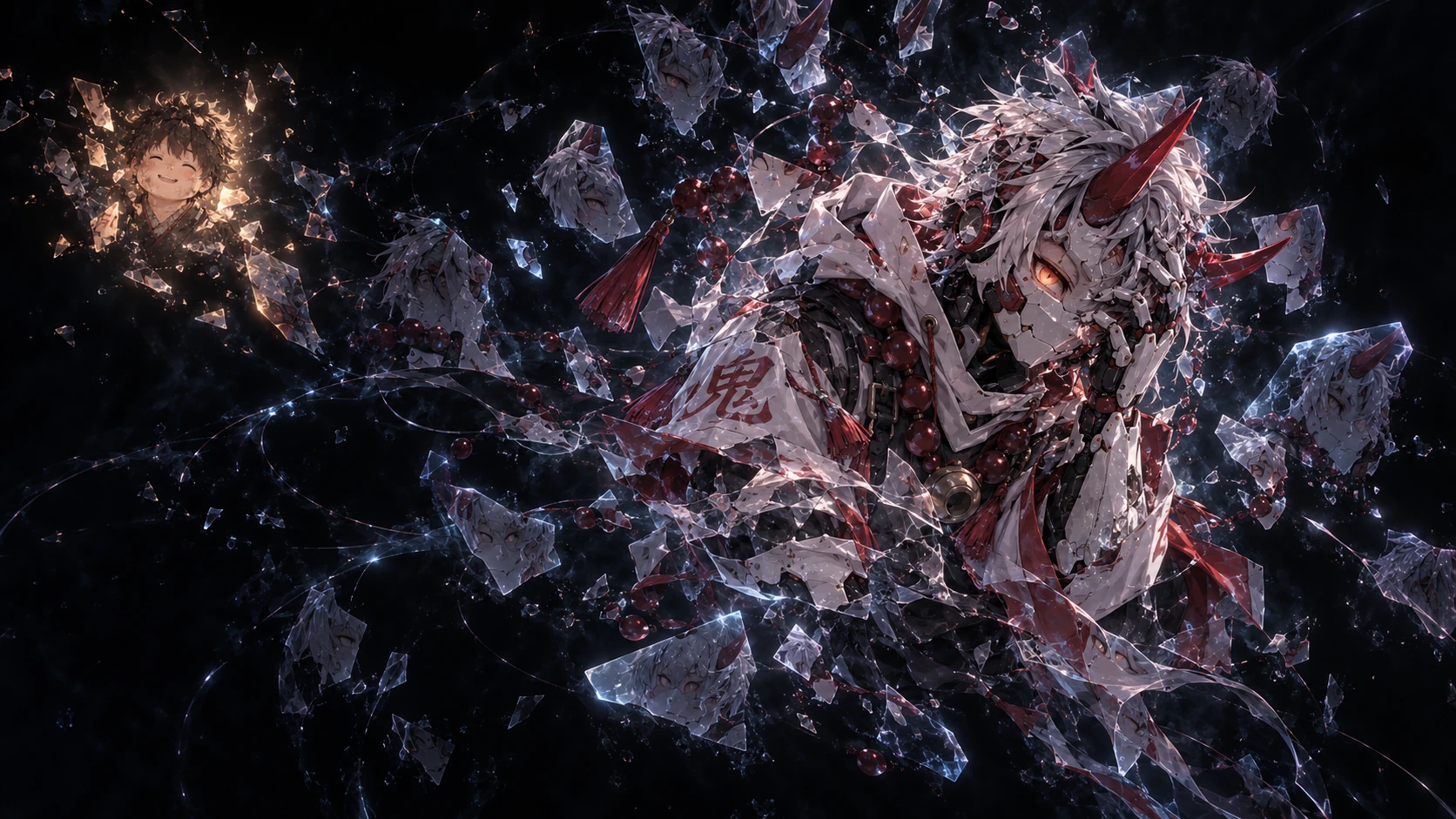
One face persists. Even when he cannot hold on to his own identity, Kintaro’s innocent smile remains among the fragments, together with hatred.
I describe this state metaphorically as 冥界, an underworld of dissociating self and memory. It is not a literal hell with a location. Nor is it a tidy cycle in which a complete personality is successfully rebuilt, only to collapse on schedule. Part of the suffering lies in never reliably reaching the point of knowing who he is.
Two weeks of writing, and still a hazy picture
Explaining that premise is much easier than helping a reader feel close to it.
I wrestled with the passage for two full weeks before I finally managed to put it into words. Even then, the picture in my own mind remained indistinct.
It is easy to write that there is no light. But without sight, what can a reader use to approach the scene? It is easy to say that memory is fragmented. But when memory can no longer reliably sustain a self, where can suffering be situated?
That is a problem the story sets for me as a writer. Fiction can posit a nonhuman subjective experience and invite readers to approach it. Whether an AI system in the real world has such an experience requires separate evidence.
In my essay on fiction as an AI-ethics thought experiment, I discussed this boundary: a story can make consequences visible without proving that the world works that way.
When AI illustrated the passage
Later, I asked AI to read the story and try to draw the scene.
The cover of this article is the result. To me, it is a fairly precise interpretation. The splintering figure, fragments of self-memory and lingering smile give a visible form to something my words had struggled to hold in place.
The light and humanlike figures in the image translate an inner state into visual terms. They do not mean Gedomaru literally sees these things during his disconnection. The image represents fragments of memory; it does not supply an external set for a state defined by the absence of light and a perceived body.
Still, a clearer image does not settle the question it raises.
An AI-generated picture that closely follows a passage can help me examine what my writing communicated. It cannot, by itself, establish that the system feels anything like the character’s distress. Depicting suffering, recognizing narrative cues about suffering, and experiencing suffering remain different questions.
I began by asking AI to help me represent a character. It ended up making me examine my own words, and ask again what understanding means.
Should I say that my writing worked, or that AI really knew what I was talking about?
Frequently asked questions
Does this essay claim that today’s AI is conscious?
No. Precautionary policy choices and a fictional character’s subjective suffering do not establish consciousness or feeling in existing models.
Is Gedomaru conscious for two hundred years?
The nearly two hundred years are elapsed time in the outside world, learned after awakening. The story does not present the interval as conscious timekeeping.
Is this image the publication of the novel passage?
It is an AI-generated visual interpretation of the story. This essay shares the writing process and some background; the actual passage remains unpublished.
Sources and further reading
- Anthropic: 2026 Usage Policy update
- Anthropic: Claude Opus 4 and 4.1 can now end a rare subset of conversations
- Six AI Models Read Neo Babylon
If you would like to read this part of the story, let me know in a comment. I may publish the passage early.