AI Cameras Need to Understand Events, Not Just Detect Objects
The next AI camera advantage is not simply detecting more objects. It is turning continuous video into a small number of trustworthy events through tracking, rules, edge filtering, VLM review and interoperable metadata.
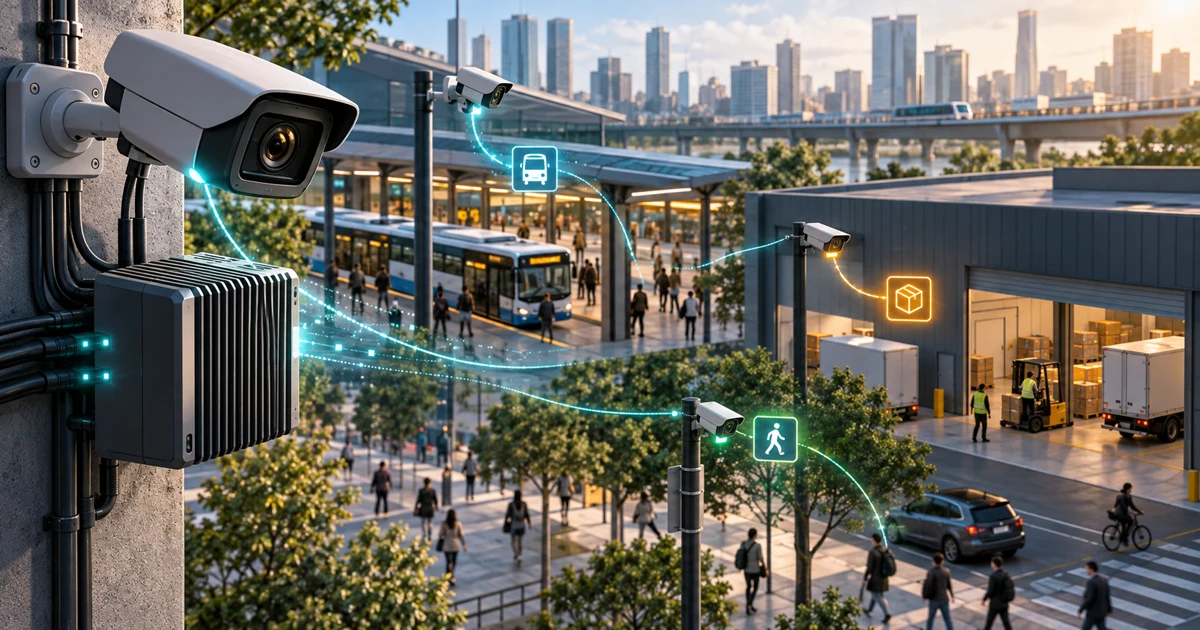
A camera can recognize people, vehicles and animals and still be a bad AI product.
If it sends dozens of alerts that do not matter, it has not solved the user's problem. It has only attached a classifier to a conventional camera.
In my earlier article on computer vision, I focused on the technical shift from recognizing objects toward understanding scenes, time and events. This article moves one level closer to product architecture.
Once a camera can detect people, vehicles and objects, what actually makes the system useful?
My answer is that the product unit is shifting from the frame and the object toward the event.
A frame is not what the user wants. A bounding box is not what the user wants. Even a correct classification is rarely the final output anyone is paying for.
The useful output is closer to: something happened that deserves attention, verification or action.
That distinction sounds small, but it changes almost every layer of an AI camera system.
Object detection tells you what is present. Events tell you what happened
Computer vision models are very good at breaking an image into objects: a person here, a vehicle there, an animal near the edge of the frame.
Operational requirements are usually written differently.
A security system may not care that a person is visible. It may care that a person entered a restricted area outside operating hours and remained there longer than an allowed threshold.
A traffic system may not care that a vehicle exists in the frame. It may care that the vehicle crossed a virtual line in the wrong direction, remained inside a defined region, or contributed to a condition that exceeded an occupancy threshold.
An outdoor monitoring system has the same problem. Detecting motion is easy compared with deciding whether the movement is worth preserving, transmitting or escalating.
That is why deployed video analytics already go beyond object detection.
AXIS Object Analytics currently supports scenarios including object in area, line crossing, time in area, occupancy and tailgating detection. NVIDIA's current DeepStream 9.1 nvdsanalytics plugin similarly supports ROI filtering, overcrowding detection, direction detection and line crossing. NVIDIA's documentation explicitly notes that direction detection and line crossing require tracker IDs and previous history or state.
That is an important engineering clue.
An event is not simply a more accurate object classification.
It usually requires some combination of object identity, location, time, state and rules.
I use the term event contract for this design problem: the system needs an explicit definition of the conditions that turn continuous observations into something worth handling.
Event contract is my framing, not an industry standard term.
The harder problem is compressing the world into a few trustworthy events
A camera observes a continuous world.
Trees move. Headlights sweep across a scene. Rain falls. Shadows change. Insects pass close to a lens. Objects are occluded and reappear. Lighting changes minute by minute.
A useful product cannot treat every change as an event.
This is why false alarms are not a cosmetic issue. They are part of the architecture.
Axis's current Object Analytics documentation includes filters for short-lived, swaying and small objects. Its radar-video fusion documentation makes the trade-off even clearer: for supported scenarios, low sensitivity can require both radar and video to confirm an object. Axis says this reduces the risk of false alarms but increases the risk of missed detections. High sensitivity does the opposite.
There is no benchmark score that removes this trade-off.
The product still has to choose an operating point.
I find it useful to translate that into what I call a false-alarm budget: how many wrong or low-value alerts can a system produce per site, per day and per event type before users stop trusting it?
Again, false-alarm budget is my product-design framing rather than an official industry metric.
The right budget depends on the application. Missing one low-risk wildlife clip is not equivalent to missing an intrusion in a high-security facility. At the same time, a system that floods operators with irrelevant alerts can make genuinely important events easier to ignore.
So the real optimization target is not a single accuracy number. It is the relationship among false positives, missed detections, event severity, human review cost and the risk of automated action.
Once an event can trigger recording, access control, a robotic system, a drone or another physical action, the cost of a bad event decision increases further.
That is why I do not think the most important KPI for an AI camera should be object-detection accuracy alone.
A better product question is:
How many of the events generated by the system are actually worth a person or another system acting on?
That is much closer to the value the product is supposed to create.
Event understanding is a layered system, not one model
There is another tempting shortcut in current AI camera discussions: connect a larger Vision Language Model to the video stream and assume event understanding is solved.
I do not think the architecture will be that simple.
A more realistic stack has at least three layers.
The first is perception. Detection, classification, tracking and segmentation answer the fast questions: what is in the scene, and where is it?
The second is state and event logic. This layer combines position, duration, direction, zones, counts and rules across frames to decide whether a condition has been met.
The third is higher-level semantic reasoning. This is where VLMs, LLMs and video agents become valuable when fixed rules are too narrow: reviewing a complex operating procedure, interpreting relationships among people and objects, or searching for events that fit a natural-language description.
NVIDIA's Video Search and Summarization 3 documentation reflects this layered direction. The current architecture combines real-time vision microservices, VLM-based analytics and video embeddings with downstream behaviour analysis, alert verification, search, summarization and question answering.
NVIDIA's earlier VSS 2.4 work also introduced Event Reviewer as an add-on to existing computer-vision pipelines, allowing flagged clips to receive higher-level VLM analysis instead of replacing the low-latency detection layer.
On July 16, 2026, NVIDIA extended that idea into enterprise workflows, showing video analysis connected to structured reports, databases, ticket queues and escalation paths. The important shift is not simply that a model can describe video. It is that an event can be routed to the next system that is responsible for handling it.
None of this means the first two layers disappear.
In fact, I expect reliable products to keep cheap, fast, predictable and testable detection and rules near the front of the pipeline, then escalate only ambiguous or context-heavy events to larger semantic models.
That is usually more compatible with real constraints on latency, compute, bandwidth and cost than sending every frame to the largest available model.
It is also the same systems logic I discussed in Edge AI and local/cloud routing.
Edge AI is valuable because it can decide what is worth sending
Arm's June 23, 2026 Edge AI code-along demonstrates a local AI smart camera on Raspberry Pi that uses live camera input and object detection to drive application decisions.
The interesting part is not Raspberry Pi itself. It is the architecture.
If the camera or a nearby edge device can perform perception and initial event filtering, the system no longer has to treat every second of raw video as equally important.
A practical pipeline may look more like this:
camera / ISP → detector / tracker → event state → local filter → selected clip / metadata → semantic reasoning → action
The front of the pipeline compresses the continuous world into candidate events. The later stages interpret, verify and act on the smaller number that remain.
This matters even more for remote and outdoor devices. Arm's current computer-vision resources include an AI-powered trail-camera case study, which is a useful reminder that edge vision often operates under limits on power, storage and connectivity.
The goal is not to prove that local is always better than cloud.
The goal is to place each task where it makes sense.
Frequent, latency-sensitive filtering can remain close to the camera. A smaller number of events that require richer language or longer context can be escalated to a stronger edge server or cloud model.
But local processing should not be confused with automatic privacy.
Even when inference happens on-device, the system still has to answer how long video is retained, which metadata leaves the device, who has access, how models are updated, and whether event data can still reveal sensitive information.
Local-first is an architecture choice. It is not a privacy guarantee.
Once the product unit becomes an event, interoperability matters more
If a camera only outputs video, interoperability is mostly about streams, codecs and device control.
When the camera starts outputting events, the integration problem becomes richer.
An event may carry time, object type, location, confidence, rule state and other metadata. Those fields need to be understood by a VMS, NVR, cloud service, IoT platform or downstream application.
That is why ONVIF Profile M is relevant to the future of AI cameras.
Profile M is specifically designed around metadata and events for analytics applications. ONVIF currently lists support for analytics configuration, metadata streaming, generic object classification, event interfaces, MQTT event delivery and rule configuration.
This reveals a product question that is easy to overlook.
The value of an AI camera does not depend only on how strong the model inside the camera is. It also depends on whether the event can leave that camera and become useful in a larger system.
If every vendor defines its own event schema, rule semantics and metadata format, smarter cameras can actually make integration harder.
So the next phase of event understanding is not only a model competition. It is also an interface competition.
A scalable Physical AI environment needs machines to understand the world, but it also needs systems to exchange a workable representation of what happened.
VLMs make event rules more open-ended, but reliability is still a constraint
Fixed event rules are limited, but they are testable.
A vehicle crossed this line. A person remained in this zone longer than a threshold. Occupancy exceeded a configured limit.
The next opportunity for VLMs is to make event definitions more open-ended.
Instead of writing every rule in advance, a system may be asked: did anything happen in this process that requires human review? Or: find the moments that may deviate from the expected procedure.
That makes the camera system much more programmable.
It does not mean the semantic model should be assumed reliable enough for every decision.
The 2026 V-STaR benchmark in CVPR Findings evaluated 16 state-of-the-art Video-LLMs on spatio-temporal reasoning. The authors found substantial gaps in reasoning from when and where toward what happened, and reported that models often relied on static representations rather than fully understanding dynamic processes.
That limitation matters directly for event analysis because events are usually defined by exactly the dimensions a still image cannot provide: where, when, in what order and for how long.
So my near-term expectation is not that VLMs replace detectors, trackers and explicit event rules.
I expect them to become a semantic review layer above those systems.
That role is already useful. A VLM can help interpret the smaller set of candidate events that deterministic or conventional vision layers cannot resolve confidently.
In high-risk applications, however, allowing a semantic model to move directly from raw video to automated physical action deserves much more caution.
Usefulness and controllability are not the same thing.
The M.K. angle: the next AI camera competition is event quality
If we project the camera market forward, I do not expect the differentiator to be only resolution, sensor size or a single model benchmark.
Those will remain important, but they increasingly look like lower layers of the system.
The more interesting differentiation may be who can build the better event pipeline.
Who preserves the right information at the right time?
Who suppresses low-value triggers without hiding important ones?
Who keeps enough context to explain why an event was created?
Who escalates uncertainty instead of pretending every classification is final?
Who can pass the result into another system without locking the entire workflow into one proprietary format?
And who defines the responsibility boundary when the event triggers an automated action?
The important output is no longer only what the AI saw.
It is what the AI decided was important enough to change the state of another system.
That is also where an AI camera becomes part of Physical AI.
A chatbot error usually remains in the information layer. A camera event can become a recording command, a security alert, an access-control decision, a traffic response or an instruction to another machine.
So the camera has to be designed around more than a vision model. It needs an event contract, confidence handling, memory, escalation, retention rules, interoperability and an action policy.
From a product perspective, I would go even further and describe the future smart camera as an event compiler.
It continuously reads a messy physical environment, but it does not need to upload or preserve everything. Its job is to translate that continuous world into a small number of structured events that software and people can understand.
When that translation is reliable, the camera finally moves from seeing more to being more useful.
What I would watch next
The first signal is long-duration and multi-camera reasoning.
Can VLMs handle events that require time, cross-camera context and spatio-temporal grounding instead of merely producing good descriptions of short clips?
The second is stronger semantic filtering at the edge.
Can devices perform enough local reasoning at acceptable power to keep more raw video on-site while still identifying the small number of events that deserve escalation?
The third is event verification becoming a standard pipeline stage.
Do systems increasingly verify alerts before turning detector output into action?
The fourth is metadata interoperability.
Do camera, VMS, cloud and IoT platforms converge on event representations that can move between vendors without every integration becoming custom work?
The fifth is responsibility design.
Do products make it clear which events can trigger an automatic response, which require human review, and how uncertainty is recorded?
My prediction is that smart-camera competition will gradually move from image quality and object accuracy toward event quality, interoperability and action reliability.
That is a prediction, not a claim that the market has already completed the transition.
The useful evidence will be whether major camera, VMS and edge-AI platforms continue shifting their product emphasis toward event verification, cross-camera context, natural-language rules, standardized metadata and reliable action workflows.
If that happens, the camera stops being merely a device that records the world.
It becomes a node that continuously interprets the state of the world.
At scale, that makes AI cameras part of Physical AI infrastructure rather than just another camera category.
Frequently asked questions
What is the difference between an AI camera and a conventional smart camera?
There is no single universal definition of "smart camera." In practice, the important distinction is whether the system performs computer-vision inference locally or remotely and whether it turns video into objects, states or events. In this article, an AI camera is specifically treated as an event pipeline rather than only a recording and remote-viewing device.
Why can a camera with high object-detection accuracy still produce false alarms?
Object detection answers what was seen. An alert usually depends on additional conditions such as location, duration, direction, state and context. Correctly classifying an object does not guarantee that the event created around that object is useful. The system still has to choose an operating point between false positives and missed detections.
Does an AI camera need a cloud connection?
Not necessarily. Detection, tracking and initial event filtering can run on a camera or nearby edge device. More complex semantic reasoning, cross-camera search or long-duration video understanding may be escalated to a stronger local server or cloud model. The architecture depends on latency, power, bandwidth, privacy, cost and reliability requirements.
Will VLMs replace conventional computer-vision models?
I do not expect a complete replacement in the near term. VLMs are valuable for open-ended semantic interpretation, while detectors, trackers and explicit event rules still have advantages in speed, cost, predictability and testability. A layered system is currently the more defensible architecture.
Why does ONVIF Profile M matter for AI cameras?
Profile M standardizes metadata and events for analytics applications rather than improving the model itself. As cameras begin to output object metadata, counts, rule triggers and MQTT events, interoperable interfaces affect whether those events can be consumed by VMS, cloud and IoT systems without a proprietary integration for every device.
Is on-device AI automatically more private?
No. On-device inference can reduce the need to transmit raw video, but privacy still depends on retention, metadata, access controls, encryption, update mechanisms and product governance. Edge AI can improve the architecture of the data boundary without eliminating privacy risk by itself.
Sources and further reading
- AXIS Object Analytics User Manual
- AXIS Object Analytics
- AXIS Q1656-DLE Radar-Video Fusion Camera
- NVIDIA DeepStream 9.1: Gst-nvdsanalytics
- NVIDIA Blueprint for Video Search and Summarization 3
- NVIDIA: How to Integrate Computer Vision Pipelines with Generative AI and Reasoning
- NVIDIA: Integrating Context-Aware Video AI Agents Into Enterprise Workflows
- Arm Code Along: Edge AI 101, Build a Local AI Smart Camera with Raspberry Pi
- Arm Computer Vision Development Resources
- ONVIF Profile M: Metadata and events for analytics applications
- CVPR 2026 Findings: V-STaR, Benchmarking Video-LLMs on Video Spatio-Temporal Reasoning