KFK and the Year 2060: Why Would the Future Miss Our Present?
Revisit KFK’s 2019 Douban Q&A about the year 2060, and ask what free transit, affordable housing and expensive fruit might tell us about what to preserve today.
← Back to the Three Messages from the Future series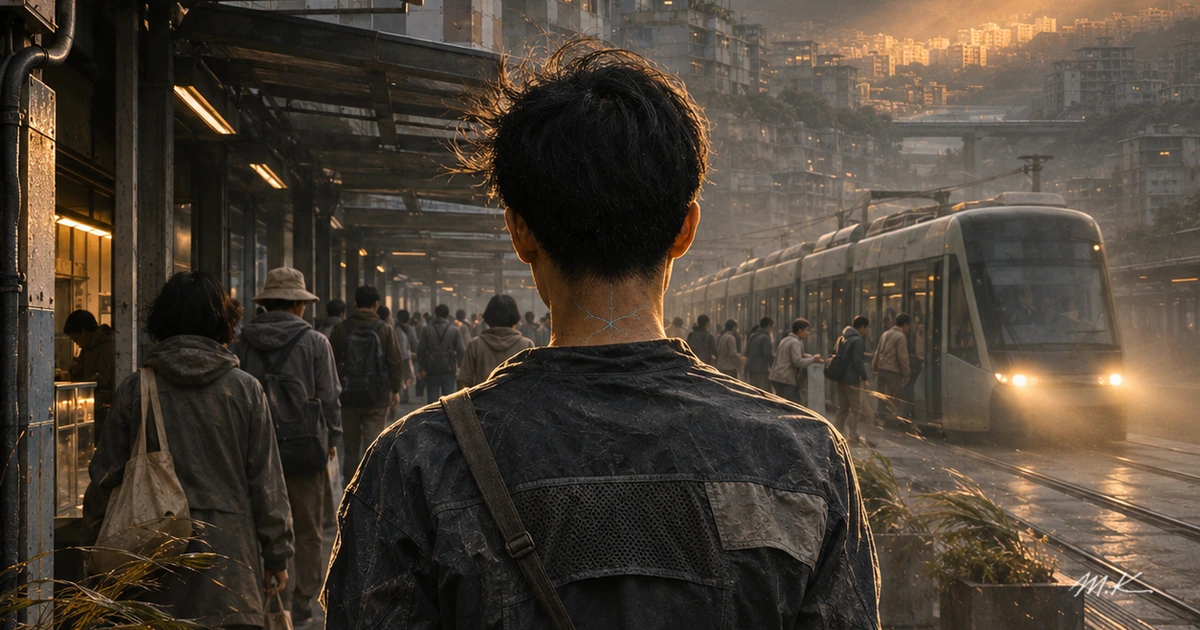
Imagine a street photograph sent back from 2060. A tram pulls in and people step aboard without stopping for tickets. The houses are built in modules, with replacement panels that no longer match. In the middle of the frame, a thin man faces away from the camera. He wears a slate-blue jacket and watches the tram pull in.
Someone on Douban asked whether people were happier
On June 22, 2019, a Douban account named KFK posted a message claiming to have arrived from 2060. When asked whether people were happier or more anxious, KFK said they were more anxious. The reply mentioned famine, earthquakes and war, and said some people missed the years from 2000 to 2030.
Some things in KFK's future sounded easier. Public transit was free and ordinary people could apply to have homes built cheaply. Fruit and milk were expensive instead. KFK also said the air had not improved and extreme weather would make some cities hard to live in. Put those details together and you get a city with new homes and trams where even a piece of fruit might take some thought.
A cheaper house can still mean an expensive move
I would ask KFK where those affordable houses are. Say your neighbourhood gets too hot or floods repeatedly. Moving inland might get you a home you can afford. It might also take you away from the neighbours who look after you, the clinic that knows your medical history and the friend who picks up your child after school. Those things are hard to put in a moving budget. They can decide whether the move works.
We can ask that question today. The IPCC finds that sea-level rise increases coastal flood risks, while risks and the ability to adapt are unevenly distributed across cities. Climate research describes risks under different conditions. People still have to decide which neighbourhoods to protect, when to help households move and how to keep work and care within reach.
What do we still have time to keep?
If someone from 2060 were sitting across from Dorami, I would ask her to put one ordinary thing on the table. A piece of fruit you do not have to save for a special occasion. A paper address you can still read in a blackout. Let the guest say which feels more unfamiliar. Then ask yourself which one is so ordinary that you have never imagined it becoming scarce.
I care most about whether the things we build now will hold up when daily life gets harder. A free tram needs to take people to clinics and jobs. An affordable home needs to be within reach of people who can help. A city needs ways to ask for help when the power or network goes down. That city may still have hazy days. Its residents could have one less reason to worry.
If you could keep one thing you take for granted today for the people of 2060, what would it be?
Listen to the conversation
Listen to Why Would the Future Miss Our Present?. In this Mandarin episode, M.K., Dorami and KFK ask what everyday things are worth keeping for 2060.
Source note. KFK is the name of a Douban account that claimed in 2019 to be from 2060. The time-travel claim is unverified. The podcast dialogue and cover scene are dramatizations. Climate risks are discussed separately using the IPCC assessment. 2019 archive of the original Douban thread · Archive-based collection of KFK's Douban replies · IPCC technical summary on climate impacts and adaptation